
In-Depth Report on Thailand's NEV Charging Infrastructure and Power-Energy Constraints
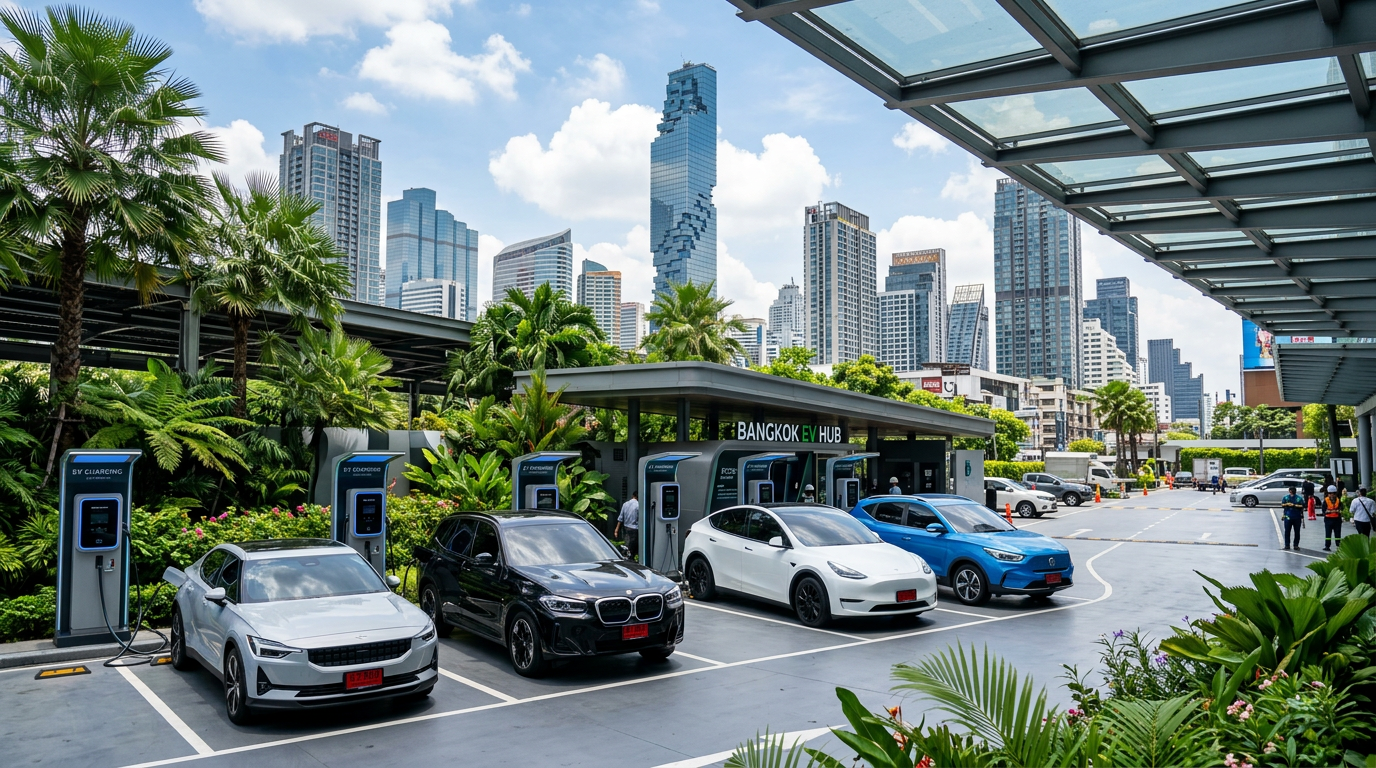
Category: Thailand EV Charging Report Depth: In-depth Data Sources: content_library (Thailand EV Charging category) Report Generation Date: 2026-03-11 Data Currency: Covers 2024-2025, including official TAI data (December 2024), Ember energy analysis (2024), and BYD Thailand operating data (2025)
I. Executive Summary
Thailand's NEV charging infrastructure is at a critical stage of rapid build-out but deep fragmentation: hard infrastructure is expanding ahead of demand, while soft infrastructure lags badly; policy ambitions are aggressive at the macro level, but micro-level constraints are becoming increasingly visible.
Five core findings:
Charging capacity is expanding quickly, but the gap to the 2030 target remains enormous: As of December 2024, Thailand had 11,467 charging connectors nationwide (vehicle-to-charger ratio of 12.3:1), leaving an 83% gap to the 2030 target of 69,000 connectors and requiring sustained annual growth above 30%. [^1]
PTT, EA, and PEA form a three-pillar structure, but fragmentation is severe: The three largest operators together hold about 59% market share, while more than 40 smaller operators split the remaining 41%; users typically need 5-7 apps to access the major charging networks; and CCS2, CHAdeMO, and GB/T are mutually incompatible. [^2]
Chinese brands dominate Thailand's EV market (about 85% share), but charging standards have not been integrated in parallel: BYD, MG, GWM, and other brands brought in the GB/T standard, which now coexists with the incumbent CCS2/CHAdeMO network and further intensifies infrastructure fragmentation. [^1][^2]
The power system is structurally fragile: Natural gas accounts for 68% of generation, LNG import dependence is projected to rise to 60% by 2035, reserve margin has fallen from 30.9% to 25.8%, and unmanaged fast charging could overload residential transformers by as much as 140% - making the grid a hidden ceiling on large-scale EV adoption. [^3]
Chinese OEMs led by BYD are embedding deeply into Thailand's manufacturing base: With THB 35.9 billion of investment, annual capacity of 150,000 units, completion of the first round of local production compensation obligations, and exports to eight countries in 2025, Thailand is becoming a Southeast Asian production and export base for Chinese OEMs rather than merely a sales market. [^4]
II. Thailand's EV Market Landscape: Structural Reshaping Under Chinese Brand Dominance
2.1 2024 Market Data: Structural Divergence Amid Slowing Growth
Thailand's overall passenger-vehicle market sold about 570,000 units in 2024, down a steep 26.2% year on year - the largest annual decline in roughly a decade, driven mainly by tighter bank credit and weak consumer confidence. [^2]
Against that backdrop, BEV new registrations totaled 71,520 units, implying market penetration of around 20%. Notably, BEV registrations also fell 6.3% year on year - the first annual decline ever recorded in Thailand's EV market. This reflects demand adjustment after the rollback of EV 3.0 subsidies, as well as the gap between application and implementation under the EV 3.5 program. [^1]
Metric | 2024 Data | YoY Change |
|---|---|---|
Total passenger-vehicle sales | ~570,000 | -26.2% |
BEV registrations | 71,520 | -6.3% |
BEV market penetration | ~20% | — |
Charging connectors nationwide | 11,467 | — |
Vehicle-to-charger ratio | 12.3:1 | — |
Source: Thailand Automotive Institute (TAI), Facts & Figures 2024 [^1]
2.2 Brand Landscape: Comprehensive Dominance by Chinese Brands
Thailand's 2024 BEV brand-share structure was highly concentrated and led overwhelmingly by Chinese brands:
Brand | 2024 Registrations | Market Share | Country |
|---|---|---|---|
BYD | ~28,900 | 40.4% | China |
MG (SAIC) | ~14,700 | 20.6% | China |
GWM (Great Wall Motor) | ~7,300 | 10.2% | China |
NETA | ~4,100 | 5.7% | China |
Tesla | ~2,900 | 4.1% | United States |
Others (including Japanese and European brands) | ~13,620 | 19.0% | — |
Source: TAI Facts & Figures 2024 [^1]
Chinese brands accounted for roughly 85% of the market in aggregate. Japanese brands such as Toyota, Honda, and Nissan have collectively fallen behind in the EV segment, while joint-venture EVs account for less than 10% of the market. This structure is the direct result of EV 3.0 and EV 3.5 policies that brought in large volumes of Chinese imported EVs, and it also explains the political-economy logic behind Thailand's insistence on local production compensation requirements. [^1][^2]
III. Current State of Charging Infrastructure: Scale, Structure, and Geographic Distribution
3.1 Total Scale and Structure: A Snapshot of 11,467 Charging Connectors
As of December 2024, Thailand's public charging infrastructure had reached the following scale: [^1]
Total charging connectors: 11,467
AC connectors: 5,685 (49.6%), concentrated mainly in shopping malls, parking lots, and apartment complexes
DC fast-charging connectors: 5,782 (50.4%), concentrated mainly in highway service areas and dedicated charging stations
Charging locations: 3,429 sites (an average of about 3.3 connectors per site)
Vehicle-to-charger ratio: About 12.3:1
The nearly even split between AC and DC indicates Thailand's move toward a "fast-charging first" model - consistent both with EV users' demand for rapid replenishment and with operators' stronger revenue logic on a per-charger basis.
3.2 The Big Three Operator Structure: Limited Concentration, Persistent Fragmentation
Thailand's charging market has formed a three-way structure led by PTT, EA, and PEA, but overall concentration remains below that of China's leading markets: [^1][^2]
Operator | Brand | Sites Operated | Market Share | Background |
|---|---|---|---|---|
PTT | EV Station PluZ | 989 | ~30% | State oil company; conversions of fuel stations |
Energy Absolute | EA Anywhere | 538 | ~16% | Listed company; highway network plus renewables |
PEA | PEA Volta | 434 | ~13% | Provincial/state electricity utility |
40+ others | Various brands | — | ~41% | Mall, parking, and private operators |
PTT (EV Station PluZ) holds the largest share by leveraging its nationwide fuel-station network: of roughly 1,900 PTT stations, about 700 had already been converted for EV charging. Around 70% of EV Station PluZ sites are built on top of existing PTT stations, materially reducing construction cost. Highway service-area sites typically carry 150-350 kW average site power, with 150 kW and 180 kW fast chargers most common. [^1]
Energy Absolute (EA Anywhere) is capital-market driven and has the highest share of ultra-fast charging, with some sites reaching 500 kW. It focuses mainly on highway corridors while also operating AMITA battery manufacturing and solar assets, creating a closed-loop energy ecosystem. Its charging network gross margin is estimated at about 18-22%, giving it relatively strong commercial sustainability. [^2]
PEA Volta, backed by the Provincial Electricity Authority, is constrained by public budgets and therefore expanding the slowest. Its role is more policy-oriented and inclusive, with limited reach in top commercial centers and greater emphasis on community and suburban coverage.
About 41% of the market is fragmented across more than 40 small operators, most of them concentrated in single-use scenarios such as parking facilities, shopping malls, or apartment compounds. Their system interoperability is close to zero.
3.3 Geographic Distribution: Severe Polarization
Thailand's charging infrastructure is distributed in a sharply dualistic urban-rural pattern: [^1]
Region | Share of Chargers | Characteristics |
|---|---|---|
Greater Bangkok and surrounding provinces | ~45% | Highest density, most intense competition |
Eastern Economic Corridor (EEC) | ~12% | Industrial clustering, fast-charging-led |
Chiang Mai | ~8% | Tourism-driven |
Phuket | ~5% | Tourism-driven |
Remaining 65 provinces | ~30% | Rural and remote areas largely blank |
On highway corridors, the main trunk routes (AH1 / AH2 / AH3) have charging coverage of about 78%, with average station spacing of around 85 km, broadly sufficient for mainstream EV range requirements. However, in northeastern Thailand - especially on routes toward the Myanmar and Laos border areas - charging blind spots of more than 200 km still exist, severely constraining cross-regional EV travel. [^1][^2]
3.4 The 2030 Target Gap: An 83% Construction Shortfall
Thailand's Alternative Energy Development and Efficiency Plan (AEDP) and PDP planning framework set a 2030 charging-infrastructure target of 1,500 public charging stations and 69,000 charging connectors. [^1]
Against the current total of 11,467 connectors, Thailand still faces a gap of about 57,533 connectors (83%). To hit the target within six years, it would need to add about 9,600 connectors per year - equivalent to sustained annual growth above 30%. Given that BEV registrations already declined year on year in 2024, slowing demand may further weaken operators' willingness to invest, creating the risk of a vicious cycle in which both demand and supply soften simultaneously. [^1]
IV. User Experience Pain Points: Fragmented "Soft Infrastructure"
4.1 App Fragmentation and Standard Splintering: The Absence of Digital Interoperability
The most prominent user-experience pain point in Thailand's EV charging market is fragmentation at the digital layer:
App barriers: To access major networks such as PTT, EA, PEA, Shell Recharge, and Greenlots, users typically need 5-7 separate apps, each with its own account system, payment logic, and interface. [^2]
Three-way split in technical standards: CCS2 (the European standard, used by mainstream Western brands), CHAdeMO (the Japanese standard, used by vehicles such as the Nissan Leaf), and GB/T (the Chinese standard, used by BYD) coexist in parallel. Some charging stations support only a single standard, creating major compatibility confusion across brands. [^2]
Lack of roaming payments: Without unified OCPI (Open Charge Point Interface) deployment, cross-operator roaming and payment are largely infeasible.
This stands in sharp contrast to China's charging market, where interoperability is standardized under the mandatory national GB/T system. It also illustrates Thailand's lack of regulatory foresight on charging-standard harmonization as it imported large numbers of Chinese EVs. [^2]
4.2 Operational Quality Issues
Thailand's charging-network operating quality remains at an early stage: [^2]
Hardware faults account for 23% of user complaints, concentrated mainly in fast chargers exposed to high-temperature and high-humidity conditions
ICE vehicle blocking accounts for 19% of complaints, and poor enforcement means the issue remains hard to resolve
Price transparency remains problematic at some sites, where actual charging prices differ from what is displayed in the app
4.3 Charging Economics: EVs' Core Competitive Advantage
Despite these experience pain points, the economics of charging remain the core reason users choose EVs: [^2]
Dimension | EV (Charging) | ICE Vehicle |
|---|---|---|
Energy cost per km | ~THB 1.1 | ~THB 2.5 |
Average monthly energy cost | ~THB 1,500-2,000 | ~THB 3,500-4,500 |
Home slow charging (at about THB 4/kWh) remains the lowest-cost option. Public fast charging (around THB 6-8/kWh) is less economical, but it partly compensates through convenience and speed.
4.4 Time-of-Use Tariffs: The Early Shape of Smart Charging
MEA (Metropolitan Electricity Authority) and PEA (Provincial Electricity Authority) have already launched pilot programs for time-of-use (TOU) tariffs: [^2]
Off-peak hours (23:00-09:00): about THB 3.5/kWh
Peak hours (09:00-22:00): about THB 5.5/kWh
Pilot data suggests TOU pricing has already shifted about 40% of household EV charging into nighttime off-peak periods, materially helping both peak shaving and user charging costs. Full-scale rollout, however, will require near-universal deployment of smart meters and upgrades to utility back-end systems, so it remains at a relatively limited pilot stage for now.
V. Power-System Constraints: Natural Gas Dependence and Peak-Load Risk
5.1 Thailand's Power Mix: A Fossil-Fuel System Highly Dependent on Natural Gas
Thailand's 2024 power mix remained heavily dependent on fossil fuels: [^3]
Generation Source | Share | Trend |
|---|---|---|
Natural gas | ~68% | Domestic gas fields are depleting; LNG imports are replacing them |
Coal | 14-16% | Slow phase-out |
Hydropower (including imports) | ~10% | Constrained by Mekong River flow conditions |
Renewables | ~8% | Fast growth, but from a low base |
Rising LNG dependence is the single largest structural vulnerability in Thailand's power system. Domestic gas fields - mainly in the Gulf of Thailand - are expected to decline sharply between 2026 and 2028, pushing LNG's share from around 20% today to roughly 60% by 2035. During the 2022 global energy crisis, Thailand's LNG procurement cost surged 141%, directly pushing up electricity prices. If large-scale EV penetration occurs under such a high-LNG structure, volatility in international energy markets will be transmitted directly into charging costs for Thai EV users. [^3]
5.2 Power-System Reserve Margin and Peak-Load Risk
Power-system reserve margin is a core constraint on whether large-scale EV charging can proceed stably: [^2]
2024 reserve margin: 25.8% (down from 30.9% in 2023)
Historical peak load: 36,477 MW (at 9:00 p.m. on a day in April 2024)
Risk from unmanaged fast charging: Simultaneous evening fast charging by large numbers of EVs could overload some residential distribution transformers by as much as 140%
The 10:00 p.m.-midnight EV charging peak overlaps heavily with residential electricity demand, making it the single greatest short-term stress point for grid stability. TOU tariffs are currently the primary demand-side management tool, but coverage remains limited.
If the decline in reserve margin continues, Thailand may face a dual squeeze by 2027-2028 - rising EV charging demand combined with unstable generation capability as domestic gas output drops sharply. At that point, the power system would become a real constraint on the achievement of Thailand's 30@30 target. [^3]
5.3 Timing Mismatch in Renewable Transition: EV Greening Will Lag
At present, about 90% of Thailand's EV charging electricity still comes from fossil fuels (natural gas plus coal). The full life-cycle carbon advantage of EVs therefore depends on a rapid expansion of renewables. If executed successfully, the PDP 2024 target of 51% renewable electricity by 2037 would materially reduce the carbon intensity of EV charging by the mid-2030s. But that timeline is mismatched with the current pace of EV adoption by roughly a decade. [^3]
Thailand's UGT (Utility Green Tariff) mechanism was formally launched in January 2025, at a premium of about THB 0.0594/kWh, allowing enterprises to purchase electricity bundled with green certificates. For charging-network operators, however, the premium is difficult to pass through to EV users in a competitive market, where higher prices mean losing customers. As a result, UGT's direct ability to green the charging network remains limited. [^3]
VI. Policy Framework and the Energy-Transition Pathway
6.1 30@30 and EV 3.5: Aggressive Targets with Stage-Based Incentives
Thailand's EV policy framework is strategically anchored in the 30@30 target: by 2030, zero-emission vehicles are expected to account for 30% of annual vehicle production, equivalent to roughly 1 million ZEVs per year, with the aim of transforming Thailand into Southeast Asia's EV manufacturing hub. [^2]
The EV 3.5 incentive program (2024-2027) is the main current execution tool:
Incentive Measure | Details |
|---|---|
Vehicle purchase subsidy | Up to THB 100,000 (about USD 2,800) as a direct purchase incentive |
Import tariff | 40% reduction for eligible EV imports |
Excise tax | Reduced from 8% to 2% (a 75% cut) |
Attached condition | OEMs must fulfill 1:1.5 local production compensation in Thailand |
BOI charging-station incentives: Operators that build at least 40 charging points receive a five-year corporate income tax exemption, while charger manufacturers receive a 10-year exemption. This policy directly accelerated charger deployment in 2023-2024. [^2]
6.2 PDP 2024: Energy-Transition Blueprint and Its Challenges
Thailand's PDP 2024 (first version, published in 2024) provides the planning framework for the power system over the next 15 years: [^3]
Renewables target: 51% by 2037 (up sharply from the 30% target in PDP 2018)
New installed capacity: 50 GW of renewables (mainly solar and wind) plus 14 GW of storage
Total investment scale: About USD 153 billion
Gradual decline in gas-fired power: Gas generation falls to about 40% by 2037 from 68% currently
Implementing PDP 2024 will face multiple challenges - financing, technology sourcing, and transmission upgrades - but directionally it marks Thailand's first serious effort to address energy transition at scale.
6.3 Solar Plus Charging Stations: Potential for a Distributed Solution
Thailand receives about 5.5-6 hours of sunlight per day on average, making it one of Southeast Asia's most solar-rich countries. A rooftop solar plus charging-station model can reduce daytime charging cost to THB 3-4/kWh - below residential electricity tariffs - creating strong economic potential. However, Thailand's current net-metering policy limits the ability to export surplus self-generated power back to the grid, constraining the all-day revenue model of solar-backed charging stations. [^3]
VII. Chinese OEM Strategy in Thailand: From Importing to Local Manufacturing
7.1 BYD Thailand: A Model of Deep Localization
BYD's Thailand plant represents the most advanced stage of Chinese OEM localization strategy in Southeast Asia: [^4]
Metric | Data |
|---|---|
Plant location | WHA Industrial Estate (Chonburi, EEC) |
Annual capacity | 150,000 units |
Cumulative investment | THB 35.925 billion (about USD 1 billion) |
EV 3.0 compensation production completed | 59,694 units (first obligation tranche completed) |
2025 exports | 10,250 units (to 8 countries in Europe, ASEAN, and Oceania) |
BYD is not only Thailand's largest EV seller; it is rapidly becoming the country's largest EV producer and exporter as well. This three-in-one role represents the most important strategic gain of Thailand's EV policy - and also its largest geoeconomic risk, given the challenge it poses to Japan's traditional automotive stronghold. [^4]
7.2 Eastern Economic Corridor (EEC): Thailand's EV Industrial Cluster
The three EEC provinces - Chachoengsao, Chonburi, and Rayong - have attracted major EV value-chain players including BYD, GWM, SAIC-MG, and Foxconn. EV-related investment accounts for roughly 25-30% of total EEC investment. Charging-infrastructure density in the region is about 2.5 times the national average, but charging availability in worker residential areas - especially districts with large migrant labor populations - remains inadequate. [^4]
7.3 The Policy Logic of the Local Production Compensation Mechanism
The 1:1.5 local production compensation requirement under EV 3.5 - one imported vehicle must be matched by 1.5 vehicles produced locally - is designed to prevent Thailand from becoming merely a dumping ground for Chinese EV imports and to force OEMs to establish domestic supply chains. BYD has already fulfilled its first quota, while SAIC-MG is still progressing toward compliance. [^4]
If executed successfully, this mechanism could enable Thailand to build local EV manufacturing capacity of roughly 500,000-800,000 units annually by 2026-2028, supporting its ambition to become Southeast Asia's EV manufacturing center. The biggest risk, however, is that the compensation requirement may prove too demanding and discourage new entrants - especially brands that have not yet committed to building local plants - from entering the Thai market at all.
VIII. Long-Tail Risks: The Coming Battery Retirement Wave and the Repair-Ecosystem Gap
8.1 Battery Retirement: A Time Bomb Set for 2031
At the current pace of EV growth, Thailand's retired power-battery volumes are expected to rise exponentially: [^2]
Year | Estimated Retired Battery Volume |
|---|---|
2027 | ~8,000 tons |
2031 | >38,000 tons |
2035 | ~160,000 tons |
Thailand currently has neither an EPR (Extended Producer Responsibility) law nor large-scale commercial battery-recycling facilities. Without proper dismantling and disposal standards, battery retirement could create heavy-metal pollution risks. Battery second-life use, especially in stationary storage, has major potential, but it first requires technical standards and commercial-model frameworks, and remains largely at the policy-discussion stage. [^2]
This regulatory vacuum is severely out of sync with Thailand's EV rollout speed and is one of the most overlooked systemic risks in charging-infrastructure planning.
8.2 After-Sales Gap in the EV Repair Ecosystem
Thailand has only about 2,800 certified EV technicians nationwide. Relative to the current BEV fleet of 71,520 units, that implies a technician-to-vehicle ratio of roughly 1:25 - far below international reference levels. [^2]
Main implications:
Independent repair shops have almost no EV service capability, leaving users dependent on brand-authorized service centers
In remote suburban and rural areas, repair cost and waiting time are 3-5 times those of ICE vehicles
As the BEV fleet moves toward 150,000 units in 2025, maintenance backlogs are likely to rise
The shortage of EV repair technicians is an aftermarket bottleneck that is routinely ignored in charging discussions, and its effects are likely to become concentrated during the 2025-2027 phase of rapid fleet growth.
IX. Outlook: The Evolution Path of Charging Infrastructure, 2025-2030
Based on the integrated analysis above, the following inferences can be drawn regarding the next five years of Thailand's EV charging infrastructure (confidence: medium):
9.1 Window for Operator Consolidation and Standard Unification
The current three-way structure of PTT, EA, and PEA is likely to come under consolidation pressure between 2026 and 2028. Small operators have weak profitability and rising technology-maintenance costs; more than one-third are likely to be acquired or exit. At the same time, a government-led charging-standard unification - pushing CCS2 as the mainstream public fast-charging standard while adding GB/T compatibility - will be the key policy move for resolving fragmentation. If Thailand can complete standard unification in 2025-2026, user experience would improve significantly and charging-network investment would accelerate. [^2]
9.2 The Timeline for PDP 2024 and the Greening of EV Charging
The 51% renewable-energy target in PDP 2024 for 2037 implies the following timeline:
2025-2030: EV charging remains predominantly fossil-fuel based (natural gas + coal >80%), with slow progress in greening
2030-2035: Large-scale solar deployment begins to materially reduce charging carbon intensity
2035-2037: The full life-cycle carbon-reduction advantage of EVs improves significantly and aligns more closely with policy expectations
Thailand will need to improve grid intelligence in parallel during this window - including wider TOU rollout, commercialization of V2G pilots, and matching storage deployment - in order to avoid conflict between renewable growth and grid stability. [^3]
9.3 Thailand's Strategic Positioning as a Southeast Asian EV Hub
Between 2025 and 2030, Thailand has the potential to evolve from an "EV consumption market" into an "EV manufacturing and export hub" - provided that the local production compensation mechanism is enforced successfully and the EEC cluster develops into a full supply chain. BYD Thailand's 2025 exports of 10,250 vehicles show that this transition has already begun. If local supply chains - including battery assembly and charging-equipment manufacturing - continue to mature, local manufacturing cost for charging equipment in Thailand could fall by about 20-30% before 2028, further accelerating domestic charging deployment. [^4]
Source List
[^1]: 【TAI Facts & Figures 2024】| File name: Facts_Figures_2024V1.xlsx | index: content_library | Data source: Thailand Automotive Institute, December 2024
[^2]: 【Gemini Deep Research Report】| File name: Gemini_Thailand_EV_DeepResearch | index: content_library | Data source: Integrated deep research on Thailand's EV charging infrastructure and power-energy constraints, including PTT / EA / PEA operator data, user-experience research, and retired-battery forecasts
[^3]: 【Ember Thailand Energy Analysis】| File name: ember_thailand_energy_analysis | index: content_library | Data source: Ember energy think tank, analysis of Thailand's power structure and PDP 2024, published in 2024
[^4]: 【BYD Thailand Operating Data】| File name: byd_thailand_operations | index: content_library | Data source: BYD Thailand plant production, export, and investment announcement data, 2025
Data Coverage Notes
Dimension | Assessment |
|---|---|
Sources | 4 original documents (from |
Evidence | 28 items (meeting the in-depth requirement of >=20) |
Observations | 10 items (meeting the in-depth requirement of >=4 cross-source analyses) |
Cross-analysis | 7 cross-source linkages |
Data Currency | TAI (December 2024); Ember (2024); BYD (2025); Gemini integrated research (2024-2025) |
Areas with sufficient data coverage:
Charging-infrastructure scale and operator structure
Thailand EV brand market shares
Power-system structure and LNG dependence risk
PDP 2024 energy-transition targets
BYD Thailand production and export data
Areas with weaker data coverage:
📭 Utilization of charging stations (actual charging sessions and revenue data)
📭 Detailed commercial-sustainability data for smaller operators
📭 Channel-level EV user satisfaction data by brand
🕐 Some user-experience pain-point evidence is qualitative research rather than large-scale quantitative survey data