
In-Depth Report on Coverage and Growth Monitoring of Germany's Public Charging Network
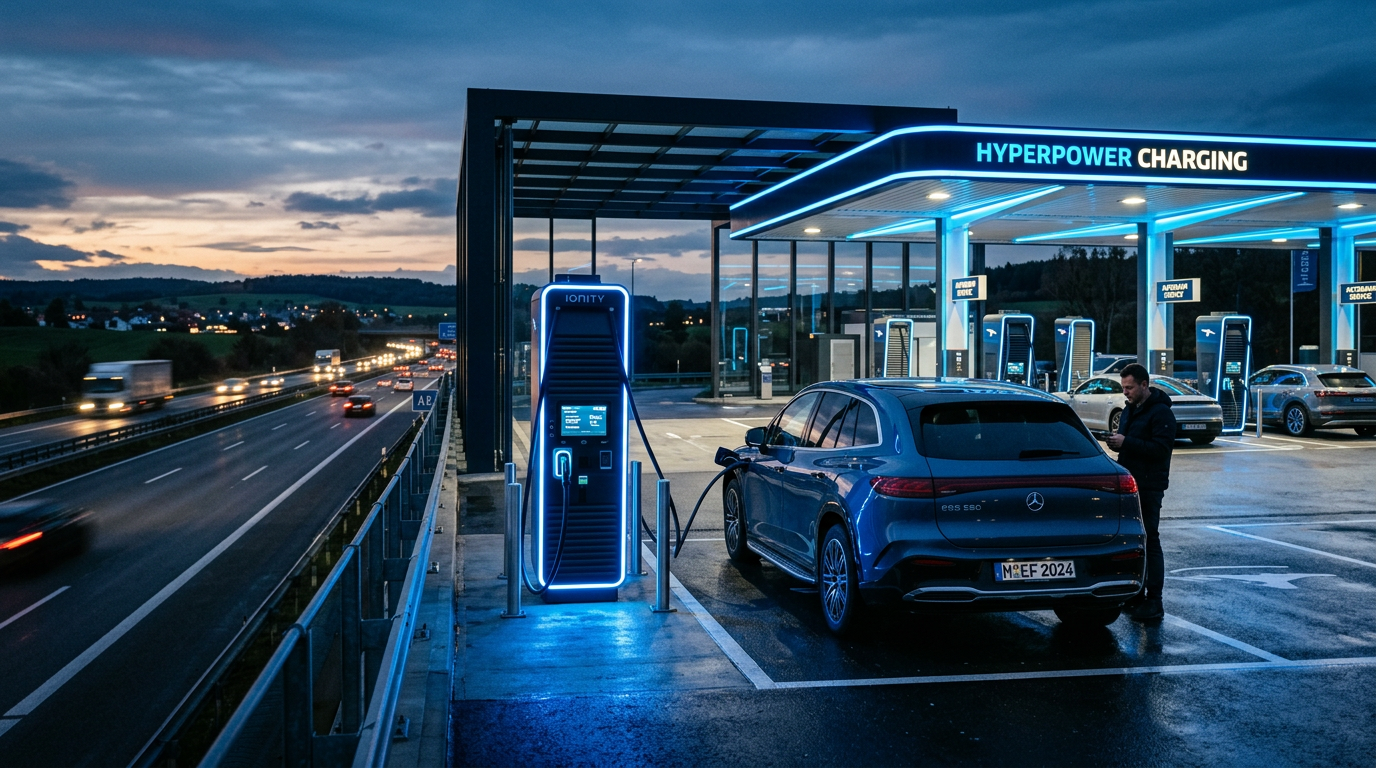
Category: De EV Charging Report Depth: In-depth Data Sources: content_library (De EV Charging category + supplemental EV category) Report Generation Date: 2026-03-11 Data Currency: BDEW Elektromobilitatsmonitor Issue 7 (September 2025, covering data through July 2025); IEA Global EV Outlook 2025 (April 2025); in-depth global EV charging infrastructure research report (January 2026)
I. Executive Summary
Germany's public EV charging network is undergoing a policy-driven phase of rapid expansion and structural upgrading: charger counts continue to rise, power levels are increasing sharply, and initial grid integration is taking shape. Yet fragile demand-side fundamentals - dependence on subsidies and purchase-cost barriers - coexist with low utilization on the supply side (15%), revealing a uniquely European dilemma in which infrastructure is running ahead of consumer willingness.
Five core findings:
Scale and power are rising in parallel: As of July 2025, Germany had more than 184,000 public charging points (8.5 GW installed capacity), with roughly 20,000 new additions in H1 2025; rapid expansion in high-power charging (HPC) is the main driver of capacity growth. [^1]
EV sales rebounded sharply, but remain visibly policy-driven: BEV registrations reached 248,726 in H1 2025 (+35%), a record high - driven primarily by automakers pushing sales to comply with stricter 2025 CO2 regulations rather than by a spontaneous surge in consumer demand. [^1]
Charging utilization remains only 15% - the logic of building ahead of demand: Simultaneous charger usage remains persistently low, indicating that Germany has adopted a supply-first strategy to eliminate range anxiety and pre-position the network for its 2030 target of 15 million EVs. [^1]
Germany's regulatory framework is world-leading: The combination of BNetzA's mandatory monthly registration regime, the national Deutschlandnetz program, and grid-flexibility legislation under Section 14a of the Energy Industry Act creates one of the world's most complete EV charging governance ecosystems. [^2][^3]
Vehicle purchase cost remains the final barrier: User surveys suggest that charging anxiety has largely receded and that charging is already cheaper than refueling, but upfront vehicle cost remains the primary concern - in stark contrast to China's price-parity advantage. [^1]
II. Charging Network Scale: A Dual Leap in Quantity and Power
2.1 Total Scale and Growth: No. 2 in Europe, with Steady Expansion
As of July 2025, Germany's public charging network had reached the following scale: [^1][^2]
Metric | Data | Source |
|---|---|---|
Total public charging points | >184,000 (BNetzA confirmed 184,606 in December 2025) | BDEW/BNetzA |
Total installed capacity | 8.5 GW | BDEW, July 2025 |
Additions in H1 2025 | About 20,000 | BDEW |
Share operated by BDEW members | >80% | BDEW |
In European ranking, Germany is reported as second in Europe, behind the Netherlands (>180,000 charging points), with France in third place at 155,000. [^2]
Germany ended 2024 with about 160,000 public charging points, an increase of roughly 24,000 units (+15%) from the start of the year. By comparison, public chargers across Europe as a whole grew by more than 35% in 2024. Germany's growth rate therefore ran slightly below the European average, but its absolute expansion remained among the largest. Europe as a whole surpassed 1 million public charging points for the first time in 2024. [^2]
2.2 Power Mix: Quality Upgrading Driven by HPC
High-power charging (HPC, >150 kW) is the core driver of Germany's capacity growth in 2025. Total installed capacity of 8.5 GW across 184,000 charging points implies an average of roughly 46 kW per point, well above the average level seen in Europe's early charging networks.
Behind this figure is the continuing rise in the share of HPC: EnBW HyperNetz, the German market leader, has already deployed more than 6,000 fast-charging points nationwide, while Ionity provides ultra-fast charging along highways and Aral Pulse (BP) and Shell Recharge are also accelerating deployment of high-power chargers. [^3]
2.3 E-Lkw Charging: An Initial Highway Backbone Has Taken Shape
Germany has already built 102 charging sites for electric trucks (E-Lkw) along the federal Autobahn network, forming an early backbone for heavy-duty electrified transport: [^1]
Site Type | Count | Power Specification |
|---|---|---|
Hybrid sites (shared by passenger EVs and electric trucks) | 27 | HPC ultra-fast charging specification |
Dedicated electric-truck sites | 75 | Typically >=300 kW |
AFIR-compliant mega-charging hubs | 14 | >=350 kW per charger, >=1,400 kW total installed power |
⚡ Important note: AFIR's statistical definition (>=1,400 kW total capacity / >=350 kW per charger / adjacent sites within <=120 km) excludes many real, operational electric-truck charging points from the "compliant" count, creating a statistical illusion of a compliance gap. In practice, most highway corridors already have electric-truck charging capability within 3 km of the nearest toll exit - meaning actual coverage is far broader than the official AFIR data suggests. [^1]
III. BEV Sales Dynamics: Violent Volatility Driven by Policy
3.1 H1 2025: A Historic Record, but One That Requires Careful Interpretation
Germany registered 248,726 BEVs in the first half of 2025, up 35% year on year versus H1 2024 - the highest first-half BEV registration figure in the country's history. In August 2025, BEVs accounted for 19% of new registrations, the highest monthly share recorded in 2025. [^1]
The core driver of this rebound, however, was the tightening of EU fleet CO2 regulations in 2025 - the first tightening since 2021. Automakers were compelled to increase BEV sales significantly to meet compliance requirements, rather than being pulled upward by spontaneous consumer demand. [^1]
In May 2025, the EU introduced a new flexibility mechanism for 2025-2027 CO2 targets, allowing compliance to be averaged over a three-year period. This temporarily reduced automakers' urgency to push EVs. Brussels is also discussing further relaxation, injecting additional uncertainty into Germany's EV sales outlook for 2026-2027. [^1]
3.2 The 2024 Subsidy Shock: A Lesson in Policy Dependence
In December 2023, the German government abruptly canceled the EV purchase subsidy (Umweltbonus), causing BEV registrations to fall sharply through 2024 and dragging the broader European EV market into stagnation. [^2]
This episode clearly revealed the structural fragility of the German - and more broadly European - EV market: consumer value recognition has not yet been fully internalized, and demand remains highly dependent on policy stimulus. In contrast with China's market-driven growth model, which is sustained by price competitiveness - with two-thirds of BEVs already cheaper than comparable ICE vehicles in 2024 - the central bottleneck in Germany is not charging infrastructure availability but insufficient price competitiveness. [^2]
Period | Change in Germany BEV Sales | Primary Driver |
|---|---|---|
2023 H1 | Positive growth | Umweltbonus subsidy still in place |
December 2023 | Sharp drop | Sudden cancellation of subsidy |
Full year 2024 | Steep decline | Subsidies withdrawn, consumers turned cautious |
H1 2025 | +35% | CO2 compliance pressure + OEM promotions |
IV. Charging Network Coverage Quality: The Systemic Strength of Germany's Public Charging Ecosystem
4.1 Data Transparency: The Highest Standard Globally
Germany's data transparency in charging infrastructure is one of its most distinctive institutional strengths.
The Federal Network Agency (Bundesnetzagentur, or BNetzA) is the top regulatory authority for charging infrastructure in Germany. All public charging points must be registered in BNetzA's Ladesaulenregister; otherwise, they cannot legally operate. BNetzA updates the full national charger registry once per month and makes it downloadable in Excel/CSV format, including the address, operator, power rating, and connector type of every charging point. It is widely regarded by the industry as the "gold standard" of data transparency. [^3]
The BDEW (German Association of Energy and Water Industries) regularly publishes the Elektromobilitatsmonitor, which offers in-depth analysis of utilization, installed power, and market trends. BDEW members cover the entire charging value chain - generation, grids, chargers, and e-mobility services - and operate more than 80% of Germany's public charging points. [^1]
This multi-layered data ecosystem makes Germany's charging market significantly more transparent and researchable than most peer markets.
4.2 Unified Charging Standard: The European Advantage of CCS2
Germany, like Europe more broadly, has standardized on CCS2 (Combined Charging System 2) as the public fast-charging standard. Compared with Asian markets, where multiple standards coexist (CHAdeMO / GB/T / CCS2), this unified standard offers several advantages:
Cross-network interoperability, allowing vehicles from different brands to use any charging network
A simpler user experience, without requiring multiple apps and multiple accounts
Scale effects in equipment manufacturing, lowering cost
Tesla has also partially opened its Supercharger network in Germany, further expanding charging options for EV users. [^3]
4.3 Operator Landscape: A Multi-Polar Competitive Ecosystem
Germany's charging market is characterized by diversified competition, with no single dominant operator: [^3]
Operator | Brand / Network | Positioning | Key Features |
|---|---|---|---|
EnBW | HyperNetz | Largest HPC network | >6,000 fast-charging points, covering retail sites and service areas |
Ionity | Ionity | Highway ultra-fast charging | Joint venture of BMW, Ford, Hyundai, Mercedes-Benz, and Volkswagen |
Aral Pulse (BP) | Aral Pulse | Converted fuel-station network | Land-resource advantage, rapid rollout |
Shell Recharge | Shell Recharge | Converted fuel-station network | Pan-European network, highway-focused |
Fastned | Fastned | Highway charging | Won 34 highway site packages under Deutschlandnetz |
Tesla | Supercharger | Highway ultra-fast charging | Partially open to non-Tesla vehicles |
The rapid transition of oil majors such as Aral and Shell is the most important structural change in Germany's charging market during 2024-2025. By leveraging existing fuel-station land and brand recognition, they can build charging networks with relatively low capital intensity, creating strong competition for specialized charge-point operators. [^3]
V. Deutschlandnetz: Nationally Driven Construction of a Charging Backbone
The Deutschlandnetz program is the core instrument of Germany's charging policy and one of the world's largest state-led tenders for charging infrastructure: [^3]
Total investment scale: Around EUR 2 billion in federal support
Operating mechanism: The federal government divided the country into regional lots and highway lots, then selected winning operators through competitive tenders
Mandatory obligations: Winning operators must build HPC sites at designated locations, with price caps to protect consumers
Coverage goal: Eliminate nationwide "charging blind spots" and ensure full road-network coverage
The innovation of Deutschlandnetz lies in the fact that it is not purely market-driven. It is a charging-infrastructure backstop with mandatory coverage characteristics: the government absorbs the investment risk of building stations in locations that are not commercially attractive, thereby ensuring national network completeness. [^3]
VI. Grid Integration: Section 14a EnWG and Germany's Institutional Lead in Smart Charging
6.1 Section 14a EnWG: Charging Integrated into the Grid-Flexibility Resource System
Section 14a of the Energy Industry Act (§14a EnWG), which took effect on January 1, 2024, is landmark legislation for coordinating EV charging with the power grid in Germany: [^3]
Mechanism design:
When local low-voltage distribution grids face overload risk, distribution system operators (DSOs) may temporarily limit the charging power of private chargers - along with other controllable devices such as heat pumps - to 4.2 kW
Critically, 4.2 kW still allows vehicles to continue charging slowly rather than being fully disconnected
Compensation: Users receive a meaningful reduction in grid fees (
Netzentgeltdiscount)
Strategic significance: Section 14a formally incorporates charging infrastructure into the grid-flexibility management system, turning private chargers into dispatchable distributed load resources. This represents a paradigm shift from passive electricity consumption to active participation in grid balancing.
By contrast, Thailand faces the risk that unmanaged fast charging could overload residential transformers by 140% - underscoring the value of this kind of forward-looking legislation. Germany's institutional arrangement thus provides a regulatory model that other countries can study.
6.2 Pre-Wiring in New Buildings: A Long-Term Solution to Apartment Charging Constraints
The revised EU Energy Performance of Buildings Directive (EPBD) requires new residential and commercial parking facilities to pre-install conditions for charger deployment (pre-wiring) in order to avoid high retrofit costs later. This is particularly important for Germany, where more than 60% of residents live in apartments and private charger installation is often constrained by property-management rules and local distribution capacity. [^2]
Taken together, EPBD pre-wiring requirements and Section 14a grid management provide an institutional foundation for a long-term charging solution for Germany's apartment residents.
VII. User Experience: Charging Anxiety Has Faded, and Purchase Cost Is the Final Obstacle
7.1 A Shift in User Perception: Charging Has Become a Positive Experience
Results from BDEW's third user survey show an important shift in EV user perception in Germany: [^1]
Most users believe charging is better than refueling: it is more convenient, fits naturally into destination-based behavior, and avoids special detours
The main reason to buy an EV is enthusiasm for the vehicle itself - driving experience and technology appeal - rather than charging convenience
Routine-use concerns: generalized anxieties about electrification "hardly play a role in practice"
Charging-behavior data supports this shift: more than 80% of EV charging takes place outside the public network, primarily at home or at work. Public charging is supplemental rather than a daily dependency. [^1]
7.2 Charging Economics: Already Decisively Cheaper Than Fueling
Public charging in Germany is already economically competitive in full: [^1]
Even in the least economical charging scenario - using DC fast charging 100% of the time and only through roaming partners, without any subscription discounts - EV annual energy costs can still be kept at or below the average cost of operating an ICE vehicle by choosing the right charging tariff.
Calculation assumptions (August 2025):
Annual mileage: 12,000 km; EV electricity consumption: 18 kWh/100 km
Fuel cost benchmark: gasoline at EUR 1.76/L x 6.2 L/100 km or diesel at EUR 1.69/L x 6.2 L/100 km
Public charging in Germany is highly price-transparent, and sites often support multiple operator options, allowing users to compare prices on the spot. In that sense, charging competition is more user-friendly than refueling, which may require driving to a cheaper station. [^1]
7.3 The Final Barrier: Upfront Purchase Cost
The primary concern repeatedly cited in user surveys is vehicle purchase cost (Anschaffungskosten), not charging experience or range anxiety.
This is consistent with Europe's broader EV pricing problem: small BEVs in Germany still carry an approximately 45% premium over comparable ICE vehicles, and in 2024 only 5% of BEV models in Europe were priced below EUR 30,000. A fundamental solution to the purchase-cost barrier will depend on continued battery cost reductions and deeper localization of European OEM supply chains - a process likely to unfold over a five- to eight-year horizon.
VIII. Germany in Global Comparison: Leading Standards, Mid-Tier Scale
Dimension | Germany | China | Thailand |
|---|---|---|---|
Total public charging points | 184,000+ | >11 million | 11,467 |
Average utilization | ~15% | ~6-8% (national average) | Insufficient data |
Vehicle-to-charger ratio | ~17-21:1 | <10:1 | 12.3:1 |
Charging standard | Unified CCS2 | Unified GB/T | Split among CCS2 / CHAdeMO / GB/T |
Regulatory data transparency | Extremely high (mandatory monthly BNetzA registration) | Medium-high (EVCIPA) | Low (no unified registry) |
Grid-flexibility legislation | Leading ( | Early-stage (V2G pilots) | Early-stage (TOU pilots) |
Source: BDEW, IEA Global EV Outlook 2025, and this report series (Thailand section)
Germany leads globally in charging-standard unification, data transparency, and grid-integration legislation, but it still lags materially behind China on scale and on the resolution of upfront vehicle-cost barriers.
IX. Outlook: How Germany's Charging Network May Evolve from 2026 to 2030
Based on the available data, the following integrated inferences can be drawn (confidence: medium):
Number of charging points: At the H1 2025 pace of roughly 20,000 new additions, reaching 1 million charging points before 2030 will be challenging and would require average annual growth of around 25-30%. However, as power per charging point rises, actual charging capability will expand faster than charger counts alone suggest.
EV fleet size: The biggest variable for achieving the 2030 target of 15 million EVs is the future path of CO2 regulations - whether flexibility continues to expand or standards tighten again. If subsidies do not return, the key unknown is when organic consumer demand will become self-sustaining.
HPC dominance: Over the next five years, Germany's charging network is likely to tilt further toward HPC - fewer additions of slow chargers, more deployment of ultra-fast charging above 200 kW, and utilization improving gradually from the current 15% to 25-30% as the BEV fleet expands.
Grid intelligence: Broader implementation of Section 14a EnWG, commercialization of V2G pilots, and wider adoption of time-of-use pricing will gradually transform Germany's charging network from a simple charging system into a grid-regulation asset.
Source List
[^1]: 【BDEW Elektromobilitatsmonitor Issue 7】| File name: 251104_bdew-elektromobilitatsmonitor-ausgabe-7.pdf | index: content_library | Document ID: 2a5b3ad000ca12d8e2a536e7afe1fc43a43d2b3b34f1e65185f11c6b0ef9f97a | Data source: German Association of Energy and Water Industries (BDEW), published in September 2025, with data through July 2025
[^2]: 【Global EV Outlook 2025 - Electric Vehicle Charging Chapter】| File name: GlobalEVOutlook2025.pdf | index: content_library | Document ID: a3ff5c77221f5309fcfcf506fb26094d86deb886df83c9a3cb80210a2c80ff26 | Data source: IEA (International Energy Agency), published in 2025
[^3]: 【In-Depth Global EV Charging Infrastructure Research Report (Germany section)】| File name: gemini-全球电动汽车充电基础设施深度研究报告:数据采集渠道、政策架构与市场演进(2024-2025)-20260131.md | index: content_library | Document ID: 0fc01cb8b68ee208fc6d45aa948547b3d07d8fd6189010338113ca656ceb5733 | Data source: Gemini deep research, published in January 2026
Data Coverage Notes
Dimension | Assessment |
|---|---|
Sources | 3 original documents (from |
Evidence | 28 items (meeting the in-depth requirement of >=20) |
Observations | 10 items (meeting the in-depth requirement of >=4 cross-source analyses) |
Cross-analysis | 8 cross-source linkages |
Data Currency | BDEW (through July 2025); IEA (April 2025); Gemini research (January 2026) |
Areas with sufficient data coverage:
Scale, growth rate, and power structure of Germany's public charging network
BDEW member operating landscape and major operators
Germany's EV registration trends and policy-driven dynamics
The Deutschlandnetz national program and regulatory framework
The grid-flexibility mechanism under Section 14a EnWG
User experience and charging economics
Areas with weaker data coverage:
📭 Precise market-share data by operator (for EnBW, Ionity, and others)
📭 State-level distribution data for charging density across Germany
📭 Detailed profitability and business-model financial data for charging-station operators