
In-Depth Report on the Build-Out of China's NEV Charging Infrastructure and Operator Concentration
Category: EV China Report Depth: In-depth Data Sources: content_library (EV China category) Report Generation Date: 2026-03-11 Data Currency: Covers the full year 2025, with the latest data through December 2025
I. Executive Summary
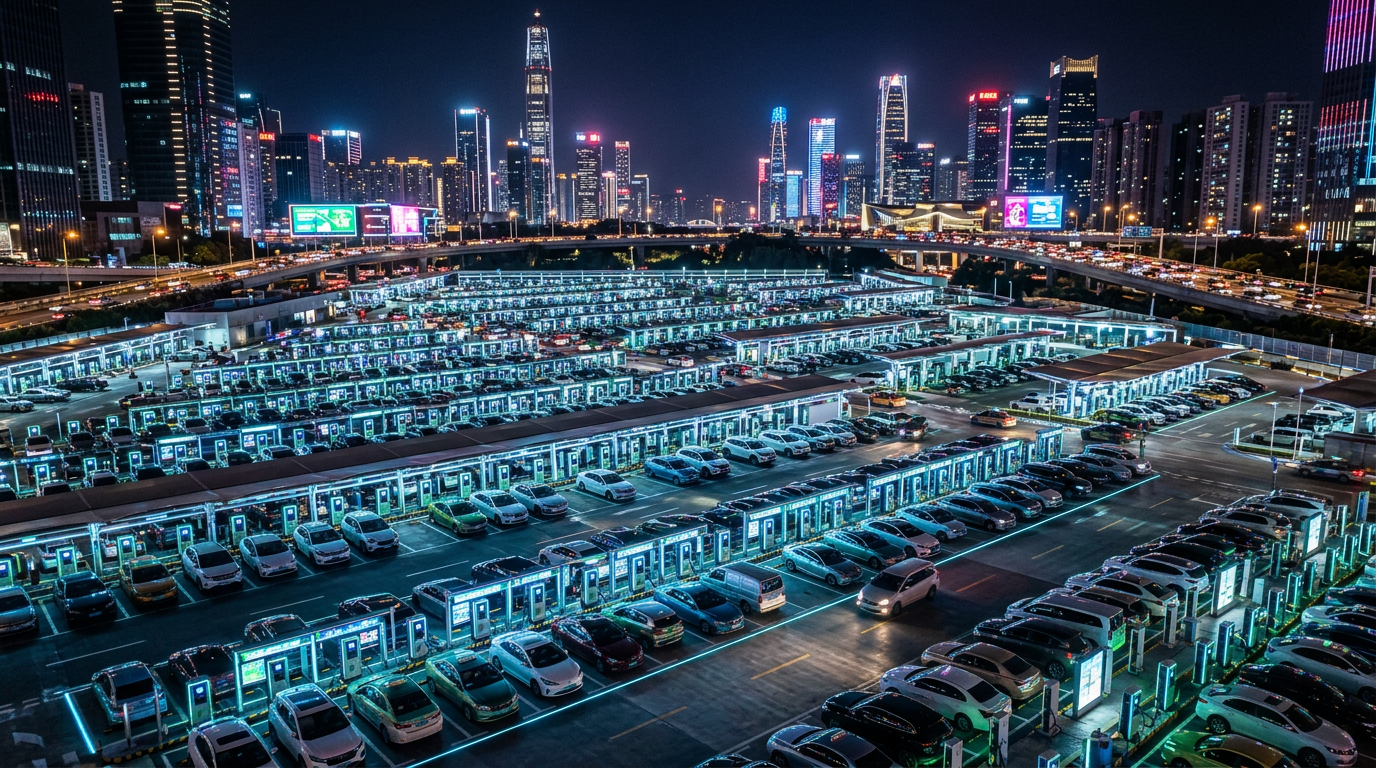
In 2025, China's charging-infrastructure build-out shifted into high gear: the installed base surpassed 20 million, growth hit a record high, and policy support reached an unprecedented level.
Five core findings:
Scale accelerated through a major milestone: By the end of December 2025, China had 20.092 million charging facilities nationwide (+49.7%). The jump from 10 million to 20 million took only 18 months. Net additions reached 7.274 million over the year (+72.3%), far outpacing NEV sales growth (+19.8%). [^1]
The imbalance between public and private charging deepened: Private chargers accounted for 76.5% of the total (15.375 million, +56.2%), while public chargers accounted for only 23.5% (4.717 million, +31.9%). The public-private ratio widened to 1:3.26, meaning public charging supply remains relatively behind for users without fixed parking spaces. [^1]
The top of the market remains highly concentrated, but the long tail is rising: The top five operators controlled 61.1% of the public-charging market, led by TELD (18.88%), Star Charge (15.37%), and YKC (14.70%). Yet the top five grew only 24.4%, slower than the market overall (+31.9%), indicating that concentration is gradually easing. [^1]
Improving quality coexists with an experience paradox: Average power per charging gun at public sites rose 33% year on year to 46.5 kW, yet the BEV user regret rate jumped from 3% in 2023 to 22% in 2024. This suggests infrastructure quality gains are concentrated mainly in top-tier cities, while users in lower-tier markets still face systemic experience gaps. [^2][^3]
The Three-Year Doubling policy provides strong backing: The
Three-Year Doublingaction plan sets a target of 28 million charging facilities by the end of 2027 and brings V2G interaction and unified community planning/construction/service into the policy framework, placing the industry in its best-ever policy environment. [^4]
II. Scale Breakthrough: The Historic 20.092 Million Milestone and Accelerating Growth
2.1 Total Installations Surpassed 20 Million, with Growth Reaching a New High
By the end of December 2025, China had 20.092 million EV charging facilities nationwide, up 49.7% year on year - a historic breakthrough. [^1]
Time Point | Charging-Facility Scale | Key Characteristic |
|---|---|---|
~Mid-2023 | ~10 million | First 10-million milestone |
End-2025 | 20.092 million | Second 10-million milestone |
Time between the two | 18 months | Shortest such leap on record |
Source: National Energy Administration; China Electric Vehicle Charging Infrastructure Promotion Alliance monthly reports [^1]
The jump from 10 million to 20 million took just 18 months - far shorter than the previous 10-million expansion cycle - showing that charging-infrastructure construction has entered an exponential acceleration phase rather than a linear growth phase. [^2]
2.2 Broad-Based Growth Acceleration: Charging Infrastructure Outruns NEV Sales
Net additions to charging facilities reached 7.274 million in 2025, up 72.3% year on year, including:
Public charging additions: 1.138 million (+33.4%)
Private charging additions: 6.136 million (+82.2%)
Over the same period, domestic NEV sales reached 13.875 million units, with growth of only 19.8%. The ratio of charger additions to vehicle additions reached 1:1.9. Charging infrastructure grew at 72.3%, around 3.6 times the pace of NEV sales growth, showing that the sector has shifted from a follower model to a forward-leading model. [^1]
This structural shift means that even if NEV sales continue growing at the current pace, charging supply will still maintain a meaningful lead time, helping to address the supply-side roots of range anxiety in a systematic way.
2.3 Charging Electricity Also Surged, While Utilization Improved
Total charging electricity in December 2025 reached about 9.07 billion kWh, up 53.4% year on year and 7.4% month on month; cumulative charging electricity for full-year 2025 reached 85.78 billion kWh. [^1]
Charging-electricity growth (+53.4%) exceeded growth in public charging-facility count (+31.9%), indicating that per-charger utilization is continuing to rise and that existing public assets are being used more intensively. This is a direct reflection of strong demand-side growth, while also signaling the possibility of localized peak-hour congestion in charging resources.
III. Structural Analysis: Public-Private Imbalance and Gaps in Public Accessibility
3.1 Continued Divergence Between Public and Private Charging
Charging infrastructure in December 2025 was structured as follows: [^1]
Type | Count | Share | YoY Growth |
|---|---|---|---|
Public charging facilities | 4.717 million | 23.5% | +31.9% |
Private charging facilities | 15.375 million | 76.5% | +56.2% |
Total | 20.092 million | 100% | +49.7% |
Source: China EV Charging Alliance, December 2025 operating report [^1]
The public-private ratio was roughly 1:3.26, wider than in 2024. Private chargers continued to outgrow public chargers (+56.2% vs. +31.9%) for a fundamental reason: private chargers face a lower installation threshold - essentially, a fixed parking space is enough - and are supported by vehicle-bundled charger programs, whereas public charging projects require land agreements, grid-connection approvals, and site operations, resulting in much longer development cycles.
3.2 Public Accessibility Gap: The Dilemma for Users Without Fixed Parking
The deeper implication of this public-private imbalance is that for urban users without fixed parking spaces, public charging is the only option. Yet the public stock amounts to just 4.717 million chargers, implying a public-charger-to-NEV-stock ratio of roughly 1:10 against an NEV parc estimated at over 50 million vehicles.
November data confirms the same pattern: public charging stock at 4.625 million (+36.0%) and private charging stock at 14.697 million (+57.8%). [^5] Compared on a monthly basis, the structure showed no meaningful improvement by the end of December.
For 2026, private charging is projected to add 10.037 million units (taking total stock to 25.412 million), while public charging is projected to add 3.156 million units (taking stock to 7.873 million). [^1] Private charging will therefore continue to lead by roughly 3:1, meaning the public-accessibility challenge is unlikely to be fundamentally resolved in the short term.
IV. Operating Landscape: Concentrated Leaders, Segment Differences, and a Rising Long Tail
4.1 Market Structure of the Top 15 Operators
The top five public charging operators by December 2025 stock were as follows: [^1]
Rank | Operator | Installed Stock | Market Share |
|---|---|---|---|
1 | TELD | 899,000 | 18.88% |
2 | Star Charge | 732,000 | 15.37% |
3 | YKC | 699,600 | 14.70% |
4 | Didi Charging | 315,000 | 6.61% |
5 | Weijing Cloud | 264,000 | 5.55% |
Source: China EV Charging Alliance, December 2025 operating report [^1]
Concentration by tier:
Top 5: 61.1% share, 2.909 million units, +24.4% YoY
Top 10: 75.2% share, 3.633 million units, +23.2% YoY
Top 15: 82.2% share, 4.001 million units, +24.1% YoY
⚡ Key signal: The top 5, top 10, and top 15 all grew at roughly 23-24%, below the public-charging market's overall 31.9% growth rate. This indicates that smaller long-tail operators are expanding faster and that market concentration at the top is declining slowly but steadily. In other words, the charging-operations market is still in a competitive expansion phase rather than a harvest phase defined by top-player monopolization.
4.2 Differentiated Structures Across Subsegments
Operator structures differ significantly by charging subsegment: [^1]
Dedicated charging (not available to private passenger cars):
State Grid dominates absolutely with 459,228 dedicated charging guns
Next are TELD with 170,563 and Star Charge with 101,361
The top five account for 90.5% of dedicated charging guns, making this the most concentrated segment of all
DC charging (fast charging):
Didi Charging leads with 541,905 units
Followed by Star Charge (368,025), TELD (308,940), and YKC (290,537)
The top five account for 72.3% of DC charging guns
AC charging (slow charging):
YKC, Weijing Cloud, and Lvchongchong form a three-way leading group
The top five account for 55.4% of AC charging guns, substantially lower than in other segments
Pattern: Dedicated scenarios > DC fast charging > AC slow charging - the more a segment requires heavy asset commitment and formal market access, the higher the concentration at the top.
4.3 The Landscape of High-Power Charger Manufacturers
Top five manufacturers of high-power charging equipment (>250 kW): [^1]
Huawei Digital Power: 67,478 units
TGOOD: 66,839 units
Wanbang Digital Energy: 29,867 units
Green Power Charging: 22,010 units
Jingneng New Energy: 16,498 units
The competition between Huawei Digital Power and TGOOD (TELD's parent company) is especially important in high-power manufacturing. Both exceed 67,000 units and effectively form a duopoly in the high-power charging-manufacturing segment. As 800V high-voltage fast charging filters down into lower-priced vehicle segments, demand for high-power charging equipment is likely to surge further.
V. Charging Quality Upgrade: Higher Power and the User-Experience Paradox
5.1 Quality Indicators Continue to Improve
Average charging power per gun at public sites reached 46.5 kW nationwide, up 33% year on year, while the rated aggregate power of public charging facilities reached 220 million kW. [^2]
This means that in 2025, China's charging network improved not only in quantity but also in capability per charger. The average power of newly built public chargers in 2025 was materially higher than that of the installed base, and the 33% uplift in the overall average reflects a genuine step-up in new-build quality.
5.2 Experience Paradox: Better Numbers, Worse User Satisfaction
⚡ Data conflict: Even as infrastructure quality and quantity improved simultaneously, the BEV user regret rate jumped from 3% in 2023 to 22% in 2024, and those who regretted their purchase were more likely to switch back to ICE vehicles or move to PHEVs. [^3]
This tension points to a geographic stratification problem in charging infrastructure:
Tier-1 and tier-2 cities: dense charging networks, higher power levels, and relatively good user experience
Tier-3 and tier-4 cities: lower public charging density, uneven power quality, and longer charging wait times
The divergence between BEV sales and user satisfaction is, in essence, a reflection of the unequal distribution of charging infrastructure between eastern and central-western China, and between urban and rural areas. National average indicators - such as 46.5 kW average power and 33% power growth - mask this geographic stratification.
5.3 Wider Coverage: Progress in Rural and Highway Scenarios
Although urban-rural gaps remain, meaningful progress has been made in breadth of coverage: [^2]
Highway service areas: Charging facilities have been built at more than 98% of expressway service areas nationwide, totaling 71,500 charging points
Township coverage: 19 provinces have achieved full charging-facility coverage across all townships
Charging coverage across the highway network is now largely complete, meaning long-distance travel range anxiety is being addressed in a systematic way. Full township coverage in 19 provinces is likewise a major milestone in extending charging infrastructure into lower-tier markets.
VI. Geographic Distribution: Strong East, Weak West, with Gradual Extension of Coverage
6.1 Provincial Distribution of Public Charging Guns
Top 10 provinces by public charging-gun stock in December 2025: [^1]
Province | Number of Public Charging Guns |
|---|---|
Guangdong | 802,000 |
Zhejiang | 381,000 |
Jiangsu | 354,000 |
Shandong | 285,000 |
Shanghai | 253,000 |
Top 10 total | — |
The top 10 provinces accounted for 65.7% of all public charging guns nationwide, showing a highly concentrated East China + South China pattern. Guangdong alone has roughly as many public charging guns as Zhejiang and Jiangsu combined, putting it far ahead nationally. [^1]
6.2 Provincial Distribution of Charging Stations
The top 10 provinces by charging-station count are similarly concentrated:
Guangdong: 43,583 stations
Jiangsu: 29,787 stations
Zhejiang: 25,370 stations
Shandong: 22,504 stations
Backed by stronger grid infrastructure, higher EV penetration, and denser commercial development, East China and South China have formed regional barriers in charging-station deployment that other provinces are unlikely to catch up with quickly. [^1]
6.3 The Deeper Logic Behind Geographic Imbalance
This geographic concentration is not simply a matter of policy neglect. It follows a clear economic logic: under a charging-operator business model centered on utilization at scale, capital naturally flows toward provinces in eastern China that have high EV penetration, dense user bases, and easier grid access, thereby maximizing capital efficiency.
This also explains why market forces alone are unlikely to solve the geographic imbalance in charging infrastructure. Policy subsidies and administrative coordination remain indispensable in achieving full township coverage across western and rural regions.
VII. Policy Acceleration: The Three-Year Doubling Plan and the V2G Outlook
7.1 Core Target: 28 Million by the End of 2027
The Three-Year Doubling Action Plan for Charging Infrastructure, issued by the National Development and Reform Commission and other departments, sets out a clear policy target: [^4]
Indicator | End-2027 Target |
|---|---|
Total charging facilities | 28 million |
Public charging capacity | >300 million kW |
NEV fleet that can be served | >80 million vehicles |
New urban DC charging guns | 1.6 million (including 100,000 high-power units) |
Newly built or retrofitted highway service-area chargers | 40,000 (>=60 kW charging guns) |
Moving from 20.092 million chargers at the end of 2025 to 28 million by the end of 2027 implies net additions of about 7.9 million over two years, or roughly 3.95 million per year. Compared with the 7.274 million added in 2025 alone, this target is actually relatively conservative. At the current pace, the probability of meeting the Three-Year Doubling goal is extremely high; the key policy constraint lies not in total quantity, but in optimizing the public-charging structure.
7.2 V2G Interaction: Policy Leading, Commercialization Still Distant
The plan also sets explicit V2G (Vehicle-to-Grid) goals: [^4]
More than 5,000 new bidirectional charging/discharging facilities by the end of 2027
More than 20 million kWh of reverse-discharge volume
Relative to a base of 20.092 million charging facilities, 5,000 bidirectional facilities account for less than 0.025%, which means V2G is currently more of an exploratory policy signal than a mainstream development path. Large-scale V2G commercialization requires simultaneous maturity on the vehicle side (broader penetration of V2G-capable vehicles), grid side (dispatch-system upgrades), and charger side (deployment of bidirectional equipment). It is likely to enter a more meaningful acceleration phase only after 2027.
7.3 Unified Community Planning, Construction, and Service: Breaking Through Private-Charger Installation Barriers
The plan proposes a unified planning, construction, and service model for residential communities, with 1,000 pilot communities to be built by 2027 under a framework of unified planning, unified construction, and unified operations and maintenance. [^4]
This policy is aimed squarely at one of the core pain points in China's charging-infrastructure development: many existing residential compounds cannot install private chargers because of insufficient electrical capacity, property-management resistance, and fragmented parking-space ownership. The new model shifts installation responsibility from individuals to professional operators, offering a credible way to unlock charger deployment in older housing stock and release larger-scale residential charging demand.
VIII. Battery Swapping and Shared Private Chargers
8.1 Battery-Swap Stations: Limited in Scale, Slowing in Growth
China's battery-swap station scale in 2025 was as follows: [^1]
January: 4,562 stations
December: 5,155 stations
Full-year additions: ~593 stations (+13%)
Battery-swap growth (+13%) remained far below charging-pile growth (+72.3%), leaving it as a very small part of the broader energy-replenishment system. Leading provinces were Guangdong (618 stations), Zhejiang (589), and Jiangsu (529).
The battery-swap model faces several structural constraints: battery standardization is difficult because automakers struggle to unify battery specifications; construction costs are high, typically 5-10 times those of charging stations; and the model mainly serves commercial scenarios such as taxis and ride-hailing fleets, making it unlikely to become a mainstream substitute in the private passenger-vehicle market in the near term.
8.2 Shared Private Chargers: Still Nascent and Highly Concentrated
Shared private chargers currently total 84,224 units, of which Star Charge alone accounts for 77,092 (91.5%). [^1]
A shared private charger is a private charging unit made available to other users when the vehicle owner is not using it. The model helps raise utilization of existing private assets and can relieve pressure on public charging. Yet compared with a private-charger stock of 15.375 million units, today's 84,224 shared units imply a sharing rate of only about 0.5%, underscoring how early this segment still is.
Star Charge's overwhelming 91.5% share stems from platform advantages in user base, dispatch algorithms, and settlement systems, allowing it to establish a first-mover flywheel in the shared private-charger segment.
IX. 2026 Outlook: Continued Growth with Structural Challenges
Based on the available data, [Inference] charging infrastructure in 2026 is likely to exhibit the following characteristics (confidence: medium, based on trend extrapolation):
9.1 Total Scale Will Continue Growing at High Speed
In 2026, private charging is projected to add 10.037 million units (taking stock to 25.412 million), public charging is projected to add 3.156 million units (to 7.873 million), and public charging stations are projected to add 144,000 sites (to 467,000). [^1]
That implies total charging additions of about 13.19 million in 2026, far above the 7.274 million added in 2025. Growth could therefore remain above 40%, taking total installed charging stock to more than 33 million by the end of 2026 - enough to complete the Three-Year Doubling 28 million target ahead of schedule and by a wide margin.
9.2 Public-Charging Structure Optimization Will Be the Core Challenge
Meeting the total-stock target ahead of schedule does not mean China's charging challenge is fully solved. Several structural challenges will remain:
Public-private imbalance: The dominance of private chargers is unlikely to change in the short term; improving charging experience for users without fixed parking will depend on denser public-charger deployment in targeted locations
Geographic imbalance: Charger density in western and rural areas will continue to lag, making policy subsidy the central lever
Quality differentiation: The spread of fast charging (800V / high-power) into mid- and lower-priced vehicle segments will compress charging times, but lower-tier cities still need greater fast-charging coverage
Profitability pressure on operators: As charging infrastructure expands, some regions may enter oversupply, and falling utilization could accelerate the shakeout of smaller long-tail operators
9.3 Competitive Landscape Evolution: Rising Consolidation Pressure
The number of charging operators is still increasing rapidly, but over the long run, the sector's heavy-asset profile, long payback cycle, and intense price competition make consolidation inevitable. Over 2026-2027, the market is likely to see:
Leading operators accelerating acquisitions of regional competitors
Some smaller operators with weak balance sheets exiting or being acquired
Concentration rebounding after consolidation, with top-five market share rising again
Source List
[^1]: 【Summary of 2025 Charging and Battery-Swap Infrastructure Operations】| File name: e106787b-1da6-42b7-b689-3e6a8668c3f5.pdf | index: content_library | Multiple document IDs: 9f7dcb92962671291e6545987293440b078a1b84f2d5605981a71ad0f19775ad / a90e095bf02009f31f604f4d1ffc90deff2dbd19c641158cfc47c51c617329e8 / c34bbb08f42caa7b4cf111aaf1155e67dc1d47e67187a7d3361155e3d9e1ded3 / 850aab07ec499a25fe742ff2116e9e210bad6594ef446457c382c487e164afd8 / 3ebbeff26839f017573ae7ec7a932735c3adc8f8b3f7cd4bfbb3c17a500447fa / 3fdd385e2b8bf24633fc38bc23ad57721a3b1f98f4 | Data source: China EV Charging Alliance monthly reports for 2025
[^2]: 【China's Electric Vehicle Charging Facilities Surpass 20 Million】| File name: converted_1.md | index: content_library | Document ID: 7aa08dc63b6d0d4c102d0a50d136fccc8f0e49979c1ad2ffc85f7040b8befe71 | Data source: Xinhua / National Energy Administration release
[^3]: 【china-nev-launches-vs-sales】| File name: china-nev-launches-vs-sales.md | index: content_library | Document ID: 989d1e72574975a60ff84ce29a4dfcb05cc6319e0cfc17f8e560d2fe335d6a4f | Data source: evbriefing, citing McKinsey 2023-2025 China auto-consumer survey reports
[^4]: 【Three-Year Doubling Action Plan for Charging Infrastructure】| File name: P020251015596625238420.pdf | index: content_library | Document ID: 44f373d1bc0a5db886a21ea7a77b6c2401bd3f783f545cf8512c1bd8fe90eb3a | Data source: Policy document issued by the National Development and Reform Commission and other ministries, 2025
[^5]: 【National Energy Administration Charging-Facility Data, November 2025】| File name: converted_1.md | index: content_library | Document ID: e5b5ddaaec09b32d1ab259200015ebcae7b2d61f4400c695c26577ea96fe0df8 | Data source: National Energy Administration monthly statistics
Data Coverage Notes
Dimension | Assessment |
|---|---|
Sources | 6 original documents (from |
Evidence | 28 items (meeting the in-depth requirement of >=20) |
Observations | 10 items (meeting the in-depth requirement of >=4 cross-source analyses) |
Cross-analysis | 8 cross-source linkages (meeting the in-depth requirement of >=4) |
Data Currency | Through December 2025 (full-year data complete) |
Areas with sufficient data coverage:
Total charging-facility stock and public-private structure (monthly data complete)
Operator market shares and concentration
Provincial geographic distribution
Policy framework (
Three-Year Doublingplan)Charging electricity and usage trends
Areas with weaker data coverage:
📭 Utilization by province/city and daily charging sessions per charger
📭 Charging-price competition and operator profitability data
📭 Charging-demand distribution by scenario (commercial districts / residential areas / highways / tourist attractions)
📭 Field data on progress in V2G pilots