
Chinese Automaker Global Expansion: Strategies & Profit Inflection Point Analysis
Date: April 25, 2026 Category: Global Expansion Depth: Medium | Structure: Research Report
I. Executive Summary
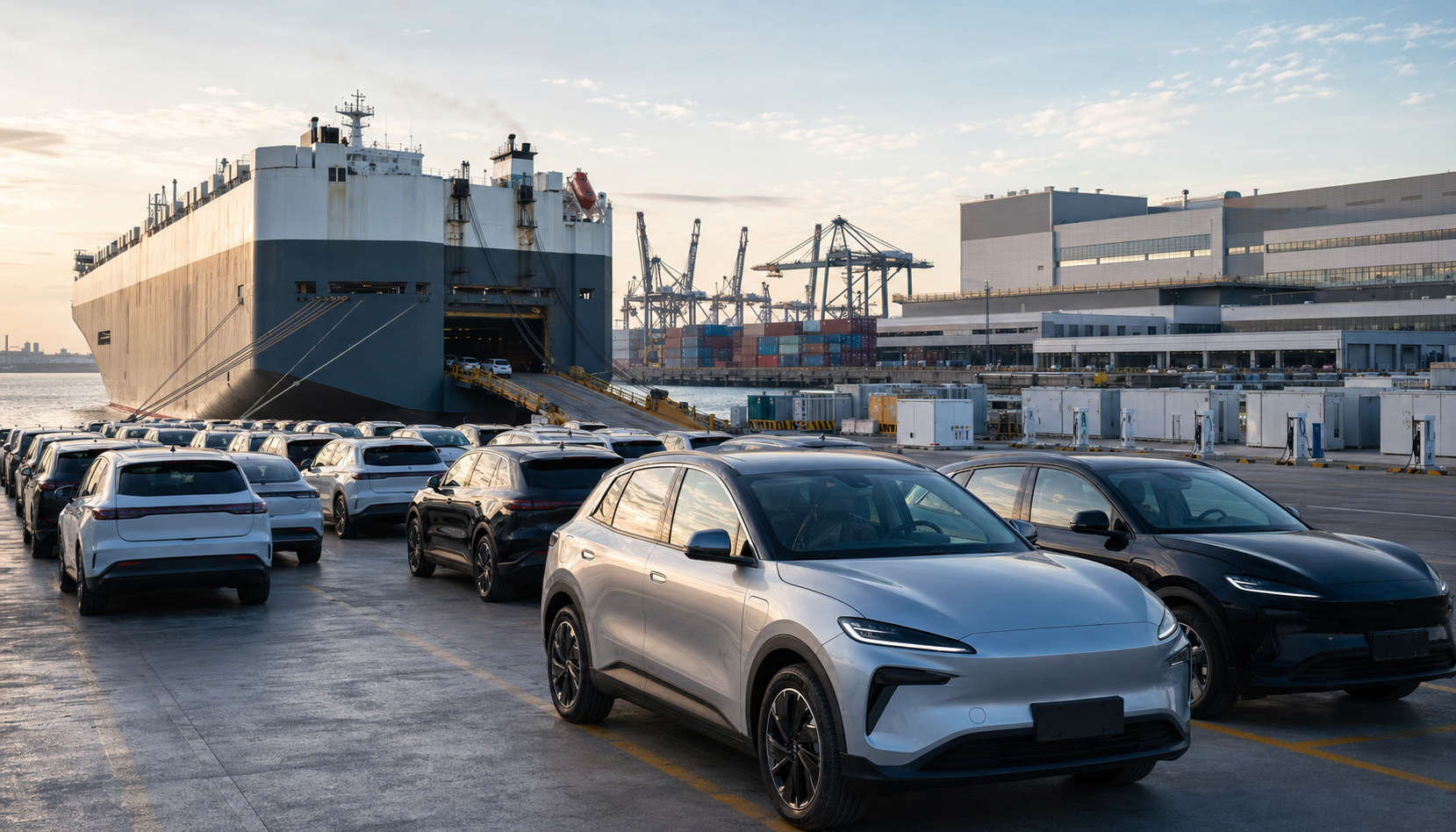
China's automobile industry has achieved a historic transformation from a domestic manufacturing base to the world's leading auto exporter, with total exports reaching 5.86 million units in 2024 (+19.3% YoY) and maintaining the #1 global position for three consecutive years.[^1] This report examines the strategic evolution of Chinese automakers' overseas expansion and identifies the emerging profit inflection point driven by global operations.
Three core findings emerge from the data:
Overseas operations have become the primary profit driver. BYD's 2024 data reveals overseas gross margins of 28.87% — 6.56 percentage points above domestic margins of 22.31% — with an average overseas selling price of 247,300 RMB per unit.[^2] This margin differential represents a structural inflection point where global operations transition from volume plays to profitability engines.
The export model is fundamentally shifting from "product export" to "ecosystem co-building." Overseas factory investment ($16B+) has exceeded domestic investment for the first time, with automakers building integrated battery-vehicle-charging networks rather than shipping finished vehicles alone.[^3]
Trade barriers are accelerating localization, not stopping expansion. EU anti-subsidy tariffs (up to 40%) and US tariffs (100%) have redirected export flows toward emerging markets (ASEAN, Middle East, Latin America accounting for 57.6% of NEV exports) while simultaneously driving factory construction in tariff-advantaged zones.[^4]
⚠️ Limited data coverage: Profitability data beyond BYD is not available in the current dataset. Findings on margin dynamics are primarily based on BYD's disclosed figures.
II. The Scale Trajectory: From Volume Surge to Structural Shift
China's auto export trajectory tells a story of rapid scaling followed by strategic recalibration. Total auto exports surged from 4.91 million units in 2023 (+57.9% YoY) to 5.86 million in 2024 (+19.3% YoY), and reached 3.08 million in the first half of 2025 alone (+10.4% YoY).[1] The decelerating growth rate — from 57.9% to 19.3% to 10.4% — reflects a maturing export model transitioning from volume-driven to quality-driven expansion.
New energy vehicles (NEVs) have emerged as the core engine of this growth. In 2024, NEV exports totaled 1.284 million units (+6.7% YoY), while H1 2025 saw a dramatic acceleration to 1.06 million units (+75.2% YoY).[1] The most striking sub-segment is plug-in hybrid electric vehicles (PHEVs), whose exports surged 193.7% in 2024 and 206.6% in H1 2025, reaching 390,000 units in the first half of 2025 alone.[1] PHEVs serve as a strategic bridge technology for emerging markets with limited charging infrastructure, complementing pure electric vehicle (BEV) exports to developed markets.
The geographic composition of exports has also shifted dramatically. Russia, once China's top export destination, dropped to #3 with a 62% volume decline following tariff adjustments, while Mexico emerged as the #1 destination.[1] NEV exports to ASEAN (338,000 units), Latin America (199,000 units), and the Middle East (202,000 units) in 2024 collectively accounted for 57.6% of total NEV exports.[4]
Emerging market adoption has accelerated rapidly: Thailand's EV sales share surged from 2% to 13% in just two years, Brazil's EV sales doubled to 125,000 units (6.4% of new car sales), and Latin America's EV fleet grew 187% YoY to 444,000 units by end of 2024.[5] Chinese NEV brands now hold over 70% market share in Thailand's NEV segment.[1]
Globally, China produced 76.9% of all EVs in 2023, with EV exports valued at $34.1 billion (1.6 million units) at an average price of $21,313 per unit — approximately half of Germany's average EV export price of $51,020 per unit.[5] China and Germany together accounted for over 49% of global EV export value in 2023, forming the dual cores of the global EV trade network.[5] China's share of global EV exports rose from 0.2% in 2017 to 10.4% in 2023.[5]
III. The Profit Inflection Point: Overseas Operations as the Margin Engine
The most significant finding of this report is the identification of a profit inflection point in Chinese automakers' overseas operations. BYD's 2024 annual report provides the clearest evidence: the company's overseas auto business achieved a gross margin of 28.87%, compared to 22.31% for its domestic operations — a 6.56 percentage point premium.[2]
This margin differential is structurally significant. BYD sold 406,000 vehicles overseas in 2024, generating 100.4 billion RMB in revenue at an average price of 247,300 RMB per unit.[2] The higher overseas margins reflect a fundamental shift in the value proposition of Chinese EVs abroad: from competing on price in developing markets to commanding technology and ecosystem premiums in more developed markets.
Cross-analysis: The structural drivers of overseas margin premium
The margin premium stems from three interconnected factors:
Technology premium in developed markets: While traditional automaker export models relied on volume-based market share gains in developing countries, Chinese EV makers can leverage technological advantages in battery systems, intelligent cockpits, and autonomous driving to command higher prices in European and other developed markets.[2]
Supply chain cost advantage: Chinese battery manufacturers hold 68.9% of the global EV battery market share (H1 2025), with six Chinese firms in the global top ten.[6] Chinese parts manufacturers in Southeast Asia produce components at 20-30% lower cost than Japanese counterparts.[2] This cost structure enables Chinese automakers to maintain premium pricing while preserving higher margins than competitors.
Scale effects of vertical integration: China's dominance in the EV value chain — from raw material refining (60% of lithium, 70% of cobalt, up to 90% of rare earth elements) through battery production to vehicle assembly — creates structural cost advantages that are difficult for competitors to replicate.[7] China produced 12.9 million EVs in 2024, over 70% of global output.[7]
BYD's global position illustrates this advantage: selling 4.27 million NEVs in 2024 (+41% YoY), capturing 18% of global EV sales, with exports growing from 242,765 units in 2023 to 417,204 units in 2024.[5]
⚡ Data tension: Traditional automakers' export margins remain significantly lower than BYD's figures. The profit inflection appears concentrated among EV-focused companies with vertically integrated supply chains, while legacy automakers transitioning to exports face a longer path to overseas profitability.
IV. Strategic Pivot: From Product Export to Ecosystem Co-Building
The evolution of Chinese automakers' overseas strategy can be characterized as a transition from "product export" to "ecosystem co-building" (生态共建). This is not merely a semantic shift — it represents a fundamental restructuring of how Chinese automotive companies engage with global markets.
Three dimensions of this ecosystem shift are evident in the data:
1. Integrated infrastructure deployment: BYD has built a closed-loop "battery-vehicle-charging network" ecosystem in Thailand, while CATL's Germany factory uses renewable energy production, and Huawei's "vehicle-road-cloud integration" solution has been deployed in the Middle East.[4] These are not standalone product exports but comprehensive ecosystem deployments.
2. Supply chain co-localization: Chinese parts manufacturers are following automakers overseas, creating localized supply chains. Tesla's Shanghai factory already has a 95%+ localization rate, with over 400 local suppliers and 60+ in Tesla's global supply chain.[2] Following Tesla's 2023 announcement of its Mexico factory, Chinese parts makers including Xinquan, Minth, Wanfeng Auto, Joyson Electronics, and Wentron have already begun mass production in Mexico, while Xusheng Group and Tuopu Group are accelerating construction around Tesla's Mexico facility.[2]
3. Technology export as a new growth vector: Chinese automotive technology companies are entering global supply chains directly. Momenta (autonomous driving solutions) partnered with Honda and SAIC Volkswagen at the 2025 Shanghai Auto Show.[2] Toyota has begun sourcing Chinese-made components in Thailand and calling on its tier-1 suppliers to adopt Chinese parts — reportedly the first time a major Japanese automaker has done so in Southeast Asia.[2]
Overseas factory investment by Chinese automakers exceeded $16 billion, surpassing domestic investment for the first time.[1] BYD is building a factory in Hungary, while Chery, Geely, and SAIC are accelerating localization investment and R&D.[4]
This shift reflects the industry's recognition that sustainable overseas competitiveness requires more than shipping finished vehicles — it demands local manufacturing capability, localized marketing, and deep supply chain integration. The top 10 automakers now hold over 85% of the global NEV market, concentrating competitive advantage among players capable of executing this ecosystem model.[3]
V. Navigating Trade Barriers: Localization and Market Diversification
Trade barriers have emerged as the primary external challenge to Chinese auto overseas expansion, but the data suggests they are accelerating strategic adaptation rather than halting growth.
Tariff landscape: In October 2024, the EU imposed five-year anti-subsidy tariffs on Chinese EVs, with rates reaching up to 40%.[4] The US raised its EV tariff rate from 25% to 100%.[4] Additionally, the EU's new Battery Regulation requires EV batteries to hold a "digital passport" by 2027, and the Carbon Border Adjustment Mechanism (CBAM) will apply carbon costs to imports of steel and aluminum from 2026.[1]
Strategic responses:
Market diversification: Rather than retreating, Chinese automakers have redirected exports toward markets with lower trade barriers and higher growth potential. NEV exports to ASEAN (338K), Latin America (199K), and the Middle East (202K) in 2024 now represent the majority of overseas volume.[4] The PHEV segment, with its 206.6% YoY growth in H1 2025, has proven particularly effective in markets where charging infrastructure is still developing.[1]
Localization as tariff avoidance: Building factories in tariff-advantaged jurisdictions has become a priority. BYD's Hungary factory serves as a gateway to the EU market, while factories in Thailand, Brazil, and Mexico provide access to regional trade agreements.[3] This localization strategy directly addresses the tariff barrier while reducing logistics costs and improving local market responsiveness.
Ecosystem lock-in: By deploying complete ecosystems (battery supply, vehicle sales, charging infrastructure, after-sales service), Chinese automakers create switching costs that make their market positions more resilient to policy changes. The "battery-vehicle-charging" closed loop in Thailand exemplifies this approach.[4]
Reverse joint ventures: Chinese companies are increasingly partnering with or acquiring foreign automakers, reversing the traditional joint venture model. This "reverse joint venture" approach enhances global supply chain positioning and provides local manufacturing credentials.[1]
The Russia experience illustrates both the vulnerability and adaptability of Chinese auto exports: the 62% volume decline following tariff adjustments was painful, but the rapid pivot to Mexico, Latin America, and Middle East markets demonstrates growing strategic agility.[1]
VI. Key Findings and Strategic Implications
Key Findings
Profit inflection confirmed: Chinese automakers have reached a profit inflection point in overseas operations, with BYD's overseas margins (28.87%) significantly exceeding domestic margins (22.31%).[2] This margin premium is structural, driven by technology premiums, supply chain advantages, and ecosystem value-add rather than temporary market conditions.
Scale-quality transition: Export growth has decelerated from 57.9% (2023) to 10.4% (H1 2025), but the quality of exports has improved dramatically — NEV exports are accelerating (+75.2% in H1 2025), PHEV exports are surging (+206.6%), and average selling prices overseas exceed domestic levels.[1]
Ecosystem competition: The competitive battleground has shifted from individual vehicles to complete ecosystems. Chinese automakers' advantage lies in their ability to deploy integrated solutions — from battery technology to charging networks to intelligent driving — rather than competing on vehicle specifications alone.
Trade barriers as catalyst, not deterrent: EU and US tariffs have accelerated rather than prevented overseas expansion by forcing strategic diversification and localization. Overseas investment exceeding $16B demonstrates that trade barriers are reshaping, not reducing, Chinese automotive global ambitions.
Strategic Implications
For Chinese automakers: The profit inflection validates the overseas expansion thesis but requires continued investment in localization. Companies that can replicate BYD's margin structure through technology differentiation and ecosystem deployment will sustain competitive advantage.
For global competitors: The 20-30% cost advantage of Chinese supply chains and 68.9% battery market share create structural challenges. Differentiation through brand, local partnerships, and regulatory positioning will be critical defensive strategies.
For policymakers: Trade barriers are reshaping rather than stopping Chinese auto expansion. The strategic response — localized manufacturing in tariff-advantaged zones, ecosystem deployment, and market diversification — suggests that effective policy must address the full value chain, not just import tariffs.
Data Gaps and Limitations
⚠️ Limited data coverage: This report relies primarily on BYD's disclosed profitability data. Financial data for SAIC, Chery, Geely, and other major exporters is not available in the current dataset.
📭 No data available for granular analysis of individual market profitability (e.g., margin by country or region).
🕐 Note: The most recent comprehensive profitability data is from BYD's 2024 annual report. Market conditions may have evolved since then.
Source References
[^1]: Quanchu_China_Auto_Overseas_2025 | File: Quanchu_China_Auto_Overseas_2025.pdf | Index: content_library | Doc ID: 7daf2ec245292819206438f1f9bff59d1099e572d234af321d0350fe2eed0ea7 [^2]: Quanchu_China_Auto_Overseas_2025 | File: Quanchu_China_Auto_Overseas_2025.pdf | Index: content_library | Doc ID: 7b5845b53a7be0a57ba424593bbb244795db9776da4c00de58add65ef7d0fd98 [^3]: nev_export_industry_word_report_dfcfw | File: nev_export_industry_word_report_dfcfw.pdf | Index: content_library | Doc ID: 04df4539a9a65b110aea6b5145009e3ae18a54f8e77222fd7f3a56a0666061bb [^4]: nev_export_industry_word_report_dfcfw | File: nev_export_industry_word_report_dfcfw.pdf | Index: content_library | Doc ID: 04df4539a9a65b110aea6b5145009e3ae18a54f8e77222fd7f3a56a0666061bb [^5]: hkust_global_ev_supply_chain_dec2025 | File: hkust_global_ev_supply_chain_dec2025.pdf | Index: content_library | Doc ID: 3d7caa4ae35c047d2f7ed412e1fc077d7aad1386eeefd50e73e29a2e91be5570 [^6]: Quanchu_China_Auto_Overseas_2025 | File: Quanchu_China_Auto_Overseas_2025.pdf | Index: content_library | Doc ID: 7b5845b53a7be0a57ba424593bbb244795db9776da4c00de58add65ef7d0fd98 [^7]: hkust_global_ev_supply_chain_dec2025 | File: hkust_global_ev_supply_chain_dec2025.pdf | Index: content_library | Doc ID: f0fbb7829aa5156e8b9822a2311679ba9050a3ea8ed76821611eb128adcc0a55
Report generated: April 25, 2026 | All data sourced from internal research database (content_library index, Global Expansion category)