
China NEV Market Dynamics: Post-Subsidy Industry Reshaping & 2026 Outlook
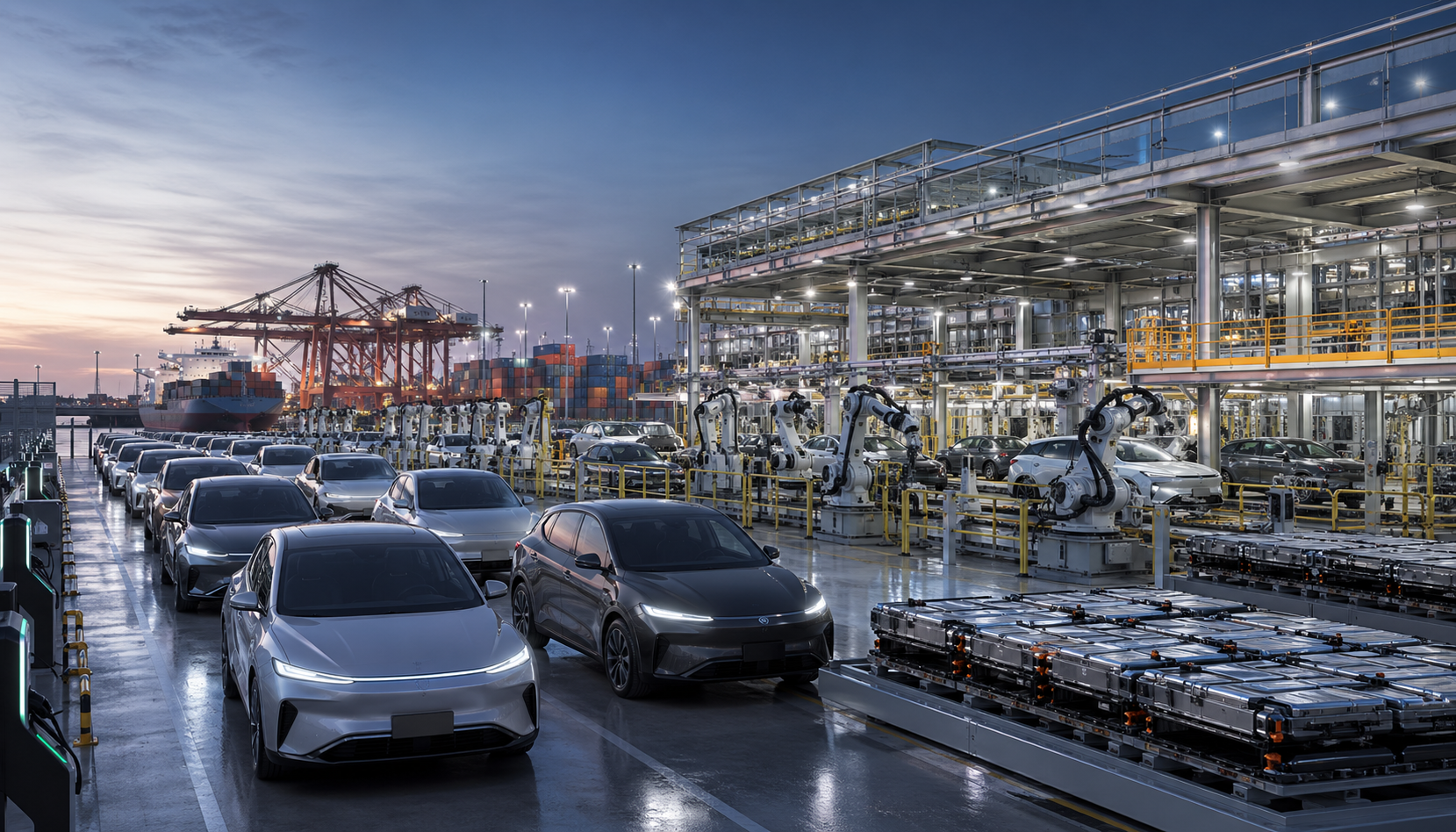
Date: April 25, 2026 Category: EV China Depth: Deep Data Sources: 10 content_library documents (brokerage research, industry reports, consulting analysis)
I. Executive Summary
China's New Energy Vehicle (NEV) industry stands at a historic inflection point. In November 2025, monthly NEV penetration first breached 50% — a milestone marking the transition from policy-driven to product-driven growth.[^1] By 2025 full-year, NEV penetration reached 47.9%, with 16.49M units sold (+28.2% YoY).[^2] China now accounts for 70.7% of global NEV sales, up from 64.8% in 2023.[^3]
This report identifies five structural shifts reshaping the industry in the post-subsidy era:
Market consolidation: Over 47 NEV startup brands have exited since 2023, while the top 5 players now control 58.3% of global NEV sales.[^1]
Competitive reshuffling: BYD's dominance is eroding across all city tiers, with Geely, Xiaomi, and Xpeng capturing significant share — challenging the assumption that vertical integration guarantees lasting advantage.[^4]
Overseas profit imperative: NEV exports surged 100%+ to 2.615M units in 2025, with overseas per-vehicle profits estimated at 3-4x domestic levels. The industry is entering a profit narrative dominated by overseas earnings in 2026.[^5]
Battery cost resurgence: Lithium carbonate prices rebounded from RMB 60K/ton (July 2025) to over 160K/ton (January 2026), threatening OEM margins already compressed by price wars.[^6]
Intelligence as competitive frontier: China's L2 ADAS penetration exceeded 50% — the highest globally — with smart driving becoming a primary purchase driver and tech companies (Huawei, Xiaomi) leveraging software advantages to gain market share.[^7]
⚠️ Limited data coverage: No structured tabular data (excel_assets) is available for the EV China category in the current database. All evidence is sourced from content_library research documents, brokerage reports, and industry analysis. Conclusions are based on available secondary sources only.
II. Market Maturation: From Policy Dependence to Self-Sustaining Growth
2.1 The 50% Penetration Milestone
China's NEV market has completed a remarkable transformation. From a mere 6.1% penetration in 2020, the market surged to 40.9% in 2024 and 47.9% in 2025.[^2] In November 2025, monthly NEV penetration exceeded 50% for the first time — a threshold that Economic Daily described as "a profound reshaping of the industrial competitive landscape."[^1]
This growth reflects a fundamental shift in the underlying growth driver. During 2015-2018, the industry was powered by direct purchase subsidies, with annual new battery capacity additions exceeding 30GWh and a proliferation of A-segment and below pure-electric platforms.[^1] The 2019-2022 period saw a rational correction: subsidy phase-down combined with technology route divergence drove second-tier battery factory utilization below 50%, and multiple startup brands faced financing crises.[^1] Since 2023, the market has entered a marketization-led phase where capacity expansion is more targeted and investment quality takes precedence over quantity.[^1]
2.2 Policy Evolution: From Subsidies to Targeted Support
The policy framework has evolved from blunt purchase subsidies to a sophisticated multi-dimensional support system:
Trade-in programs: 2025 auto trade-in programs exceeded 11.5M units, with subsidies weighted toward NEVs.[^8]
Tax policy transition: The 2026 NEV purchase tax exemption shifted from full exemption to a 50% reduction, representing a deliberate but gradual phase-down.[^5]
Infrastructure focus: Policy emphasis has shifted from consumer subsidies to charging network construction and vehicle-to-grid (V2G) pilot programs.[^1]
Dual-credit system: This continues to provide a regulatory floor for NEV production, complemented by super-long special treasury bond support.[^9]
The policy design reflects a "steady stock, promote transformation" gradual logic — maintaining growth momentum while reducing fiscal burden.[^9]
2.3 Infrastructure as Growth Enabler
China's charging infrastructure advantage is structurally significant and difficult to replicate:
Metric | China | Europe | United States |
|---|---|---|---|
Charging piles per 10K vehicles | ~120 | ~45 | ~28 |
800V platform model share | 23% | — | — |
Urban average charging time | <22 min | — | — |
Highway fast-charging coverage | >95% | — | — |
Total cumulative charging piles | >10M | — | — |
Sources: [^1]
This infrastructure density has materially reduced range anxiety — historically the single largest barrier to NEV adoption. Combined with the fact that Gen Z buyers (now 40% of the purchasing cohort) are more sensitive to smart features than traditional brand premiums, the demand-side dynamics have fundamentally shifted.[^1]
2.4 Lower-Tier City Adoption
NEV penetration in Tier-4 and below cities reached 46.5% in the first 10 months of 2025 — only 5.5 percentage points below the national average, representing the narrowest gap since 2022.[^4] This geographic broadening means that "every city with meaningful auto sales volume becomes important to NEV makers," reflected in rapidly expanding showroom networks for new NEV brands in lower-tier cities.[^4]
III. Post-Subsidy Competitive Landscape: The Great Reshuffling
3.1 Industry Consolidation
The post-subsidy era has triggered a wave of industry consolidation. Between 2023 and 2025, over 47 NEV startup brands globally ceased operations or were acquired.[^1] This represents the natural outcome of an industry transitioning from a subsidy-fueled gold rush to market-driven competition.
Market concentration has increased correspondingly: BYD and Tesla together hold 38.7% of global NEV sales, while the top 5 players account for 58.3%.[^1] The competitive structure has evolved into a "pyramid + olive-shaped" composite: at the apex are technology-driven companies with full-stack self-development capabilities; in the middle are scale manufacturers leveraging vertical integration for cost leadership; at the base are specialized brands focused on niche segments.[^1]
3.2 BYD's Eroding Dominance
Perhaps the most significant competitive development is the erosion of BYD's market share across all city tiers and both BEV and PHEV segments:
BEV Market Share Changes (First 10 Months 2025 vs. Prior Year):[^4]
City Tier | BYD Change | Biggest Gainer | Tesla Change |
|---|---|---|---|
Tier-1 | -3.5ppts | Xiaomi +5.0ppts | -4.4ppts (Tier-2) |
Tier-2 | -4.5ppts | Xiaomi +5.1ppts | — |
Tier-3 | -8.2ppts | Geely +8.9ppts | — |
Tier-4+ | -7.6ppts | Geely +6.7ppts | — |
PHEV Market Share Changes:[^4]
Tier-1: Li Auto lost -7.7ppts; Geely gained +2.6ppts; Chery +2.3ppts
Tier-2: BYD's PHEV share fell from 57.8% (2022 peak) to 36.2%
Tier-3: BYD lost -7.4ppts; Geely gained +4.2ppts
BYD remains dominant in absolute terms (40.8% PHEV share in Tier-1, still the largest BEV player in Tier-3 at 24.5%), but the trajectory is clear: competitors are catching up by leveraging scale economics to launch comparable models at competitive prices.[^4]
3.3 The New Competitive Order
Geely emerged as the biggest share gainer across all city tiers in both BEV and PHEV segments. In Tier-2 BEV, Geely surpassed Tesla to become the second-largest player by retail volume.[^4] The company's success stems from successful NEV model launches, improving product mix with high-margin models (Zeekr 9X, Galaxy M9), and accelerating NEV exports.[^6]
Xiaomi gained the most BEV share in Tier-1 and Tier-2 cities (+5.0-5.1ppts YoY), reflecting the power of its ecosystem approach and brand appeal to younger, tech-savvy consumers.[^4]
Xpeng gained +3.3ppts in Tier-2 BEV, aided by strong sales volume with net profit breakeven expectations and first-mover advantage in humanoid robotics among Chinese automakers.[^6] Xpeng's stock price was the best performer among Chinese NEV startups YTD (+84%).[^6]
3.4 Profitability Divergence
OEM profitability remains under severe pressure. CMB International forecasts that "competition will continue, credit quality divergence is obvious" in 2026, with factory closures and production line upgrades necessary to eliminate backward capacity.[^10]
Stock market performance reveals the divergence:[^6]
Company | YTD Stock Performance |
|---|---|
Xpeng | +84% |
Leapmotor | +77% |
NIO | +45% |
Geely | +19% |
BYD | +12% |
Li Auto | -24% |
The market is rewarding companies with strong sales growth and profitability trajectories (Xpeng, Leapmotor) while penalizing those facing margin compression (Li Auto). BYD's modest +12% return reflects concerns about share erosion despite its vertical integration advantage.[^6]
BYD remains the profitability benchmark among Chinese OEMs, maintaining vehicle gross margins above 18% through blade battery technology and DM-i hybrid systems.[^1] However, this margin advantage is being tested by rising battery costs and intensifying competition.
IV. The Overseas Profit Imperative
4.1 Export Surge
Overseas expansion has transformed from a supplementary growth channel into the primary profit engine for China's auto industry:
2025 NEV exports: 2.615M units (+100% YoY), representing 36.8% of total auto exports (up from 21.9% in 2024).[^2]
Jan-Feb 2026 NEV exports: 583K units (+110% YoY), now 43.1% of total exports.[^2]
Total auto exports 2025: 709.8M vehicles; traditional vehicle exports declined -2.0%.[^2]
The export-to-domestic sales ratio for passenger vehicles reached 1:2 in January-February 2026, a significant breakthrough from the 1:4 ratio in 2025.[^5]
4.2 OEM Overseas Revenue Composition
OEM | 2025 Overseas Revenue Share |
|---|---|
Chery | 52.42% |
GWM | 41.59% |
BYD | 38.65% |
SAIC | 23.18% |
Geely | 21.39% |
Changan | 16.89% |
GAC | 17.63% |
Source: [^5]
Chery was the first to exceed 50% overseas revenue share, with Q1 2026 overseas sales reaching 67% of total.[^5] BYD's overseas revenue share is growing rapidly and expected to increase further in 2026.[^5]
4.3 The Overseas Profit Premium
The critical insight is not just volume — it's margin. Overseas per-vehicle profits are estimated at 3-4x domestic levels.[^5] With the total addressable export market (excluding US, Japan, India, Korea, and China domestic) estimated at approximately 30M vehicles — comparable to China's domestic market — the profit opportunity is enormous.[^5]
For context, the comprehensive OEM overseas revenue exceeded RMB 800B in 2025 (+36% YoY), representing 32.66% of total revenue (up 7.48ppts YoY).[^5]
⚡ Data tension: Domestic auto sales declined -8.8% YoY in January-February 2026 (4.152M units) while exports grew +48.4% (1.352M units).[^2] This divergence suggests the industry is becoming increasingly dependent on overseas markets for growth and profitability, creating vulnerability to trade policy shifts (e.g., EU anti-subsidy investigations, tariff barriers).
4.4 From Product Export to Localized Manufacturing
China's auto industry is transitioning from "product export" to "system-level globalization":[^2]
BYD: Building factories in Thailand, Brazil, Hungary, and Indonesia.[^2]
SAIC, Changan, Xpeng: Establishing production bases globally.[^2]
Leapmotor: Partnering with Stellantis, operating a Poland factory.[^2]
This "export -> KD assembly -> full-process factory" progression not only circumvents trade barriers (such as EU anti-subsidy investigations) but also drives upstream battery, motor, and controller suppliers to co-locate overseas.[^9] In 2024, 37% of Chinese NEV overseas production bases had complete three-electric-system local supply capability, up 22 percentage points from 2021.[^9]
V. Battery Cost Resurgence and Margin Pressure
5.1 Lithium Carbonate Price Trajectory
After a prolonged decline, battery raw material prices have reversed sharply:
July 2025: Lithium carbonate at ~RMB 60K/ton (trough)[^6]
November 2025: ~RMB 93K/ton (+55% from trough)[^6]
January 2026: RMB 160.4K/ton (+35.9% MoM)[^8]
March 2026: RMB 171.9K/ton (+19.6% week-over-week)[^11]
Related materials also surged: lithium hydroxide at RMB 162.6K/ton (+18.1% WoW), LFP cathode at RMB 59.4K/ton (+9.4% WoW).[11]
5.2 Impact on OEM Margins
This cost resurgence poses a significant threat to OEM profitability at a time when domestic price competition remains intense. CMB International explicitly warns that "battery price hikes may dent OEM margins" in 2026.[^6]
The margin pressure creates a competitive dynamic that favors:
Vertically integrated OEMs like BYD, which produces its own batteries and can absorb cost increases internally.[^1]
OEMs with strong supplier relationships and long-term contracts that lock in pricing.
OEMs with premium product mixes that can pass costs to consumers.
⚡ Data tension: Rising battery costs benefit battery manufacturers (CATL's market cap accounts for 80%+ of the battery-maker peer group) but threaten OEM margins.[^6] CATL achieved a 38.2% global battery market share in 2024 with 30+ external supply customers.[^9] However, through controlling Bonpru Recycling and participating in CMOC, CATL has achieved >45% self-supply rate for regenerated nickel and cobalt materials, reducing battery BOM costs by 12%.[^9] This vertical integration at the battery level creates a cost asymmetry that non-integrated OEMs must navigate.
5.3 PHEV Resurgence
Interestingly, rising battery costs may partially explain the PHEV market dynamics. PHEVs require smaller battery packs than BEVs, making them relatively less sensitive to battery price increases. CMB International notes that "PHEVs are regaining traction" in 2026, partly driven by subsidy phase-down and battery price increases.[^6]
In the first 10 months of 2025, PHEV market share was relatively flat across city tiers at approximately 18-20% of total passenger vehicle retail sales.[^4] However, Geely emerged as the biggest PHEV share gainer across all tiers, suggesting that competitive PHEV offerings can still capture share despite broader market dynamics.[^4]
VI. Intelligence as the New Competitive Frontier
6.1 Smart Driving Penetration
China leads the world in smart driving adoption, with L2 ADAS penetration exceeding 50% — the highest globally.[^7] The smart driving market is expected to approach RMB 450B by 2025.[^7]
Key developments:
Price democratization: BYD, Xpeng, and Leapmotor are driving smart driving features down to sub-RMB 100K vehicles (highway NOA) and sub-RMB 150K vehicles (urban NOA).[^7]
Map-free NOA: Huawei's AITO lineup, Xpeng, Li Auto, and NIO are all transitioning to map-free urban NOA solutions, eliminating dependence on high-precision mapping and enabling faster geographic coverage.[^8]
HarmonyOS ecosystem: HarmonyOS Intelligent Driving delivered 589.1K vehicles in 2025, reaching the 1M cumulative delivery milestone in just 43 months — the fastest among Chinese new-force brands.[^7]
6.2 Software as Profit Center
New-force companies are building software service ecosystems as a "second profit curve":[^9]
NIO Banyan system: Subscription services covering smart driving, cabin entertainment, and exclusive services; Q3 2024 software business gross margin reached 72.4%.[^9]
Xpeng XNGP: Subscription penetration exceeded 31%, with AR-HUD navigation and space-to-space smart driving creating strong paid stickiness.[^9]
Tesla FSD: Continues to expand global rollout, with V13 accelerating deployment.[^1]
This "hardware standardization, software differentiation, service continuity" business model is driving OEMs from one-time sales toward full-lifecycle value operations.[^9]
6.3 Tech Company Competitive Advantage
Xiaomi's success (+5.0ppts BEV share in Tier-1 cities)[^4] validates the thesis that ecosystem integration and software capability are becoming decisive competitive factors. Huawei's HarmonyOS Intelligent Driving model (five brands: AITO, Luxeed, Stelato, Maextro, Shangjie) and Qiankun mode (three new brands: Huajing, Qijing, Yijing) demonstrate how tech companies are leveraging their software and AI expertise to compete in the auto space.[^7]
This creates a structural challenge for traditional automakers: while they excel at manufacturing efficiency and supply chain management, they must build or acquire software and AI capabilities at pace to remain competitive.
VII. Structural Advantages and Global Implications
7.1 LFP Technology Leadership
China's dominance in lithium-iron-phosphate (LFP) battery technology, accounting for >65% of domestic NEV installations in 2024, provides a cost, safety, and cycle-life advantage that is well-suited for mass-market vehicles.[^1] This contrasts with European manufacturers' early reliance on NCM/NCA chemistry, which faced thermal runaway risks and cobalt/nickel resource constraints.[^1]
7.2 Supply Chain Integration
China's NEV supply chain advantage extends beyond batteries:
Vehicle-grade chip localization rate: 32% (up from negligible levels).[1]
Smart cabin domain controller cost: Down 45%.[^1]
2024 NEV-related PCT patent applications: +18.5% YoY globally, with China the primary contributor.[^1]
The "material-component-system-complete vehicle" full-chain integration enables cost leadership that is difficult to replicate.[^9] CATL's vertical integration — from controlling battery production through recycling to material regeneration — reduced raw material comprehensive costs by over 12% and operational efficiency by 23%.[^9]
7.3 Implications for Global Auto Industry
The combination of LFP technology leadership, supply chain integration, and manufacturing scale means Chinese NEV manufacturers have a structural cost advantage. When combined with the smart driving and software ecosystem advantages, this creates a competitive position that extends beyond cost into technology and user experience.
The global implications are significant: with the addressable export market estimated at 30M vehicles (comparable to China's domestic market) and overseas profits 3-4x domestic levels, Chinese OEMs have both the incentive and the capability to capture significant global market share.[^5]
However, this expansion faces increasing geopolitical headwinds — EU anti-subsidy investigations, potential tariff barriers, and local content requirements in various markets. The industry's response — localized manufacturing in Thailand, Brazil, Hungary, and Indonesia — represents a strategic adaptation to these challenges.[^2]
VIII. Key Findings and Forward Outlook
8.1 Synthesis of Cross-Observation Analysis
The data reveals an industry at a critical juncture where multiple forces are simultaneously reshaping the competitive landscape:
The 50% penetration milestone coincides with consolidation acceleration — the market is maturing rapidly, and the survivors are those who can compete on both cost and technology.[^1]
BYD's share erosion is occurring despite its vertical integration advantage — suggesting that the competitive moat from vertical integration is narrowing as competitors achieve comparable scale and supply chain access.[^4]
The overseas profit imperative creates both opportunity and vulnerability — while overseas margins are 3-4x domestic levels, the growing dependency on export revenues creates exposure to trade policy risks.[^5]
Battery cost resurgence threatens to compress OEM margins at the worst possible time — when domestic competition is intensifying and companies need to invest heavily in smart driving and overseas expansion.[^6]
Smart driving democratization is leveling the competitive playing field in one sense (features available at lower price points) while creating new advantages for companies with software ecosystem expertise (Huawei, Xiaomi).[^7]
8.2 Near-Term Risks
Battery cost trajectory: If lithium carbonate continues rising toward RMB 200K/ton, OEM margin compression will accelerate, potentially triggering another wave of consolidation.[^6]
Trade policy escalation: EU anti-subsidy tariffs and other trade barriers could disrupt the export growth narrative that is critical to industry profitability.[^9]
Domestic demand weakness: January-February 2026 domestic sales declined -8.8% YoY, suggesting domestic demand may be weakening faster than expected.[^2]
Policy phase-down impact: The 2026 purchase tax exemption reduction from 100% to 50% may create a demand cliff similar to previous subsidy reductions.[^5]
8.3 Data Gaps and Limitations
📭 No structured tabular data: The excel_assets index contains no data under the "EV China" category. All evidence is sourced from content_library research documents and brokerage reports.
📭 Limited OEM-level financial granularity: While brokerage reports provide directional insights, detailed OEM-level cost structures and margin breakdowns are not available in the current database.
📭 Consumer behavior data: Survey data on consumer purchase drivers, brand switching behavior, and satisfaction metrics is not available in the current database.
🕐 Data timeliness: Some data points are from 2024 or earlier and may not fully reflect the most recent market dynamics.
Sources
[^1]: boc_nev_competition_20251225 | File: boc_nev_competition_20251225.pdf | Index: content_library | Doc ID: 4d0bd7aca89b8698e9a32f8bab10b650cde05034d7e70ad1955462f152d5fcd4 / 88bbd347529538dc7aa7fdd89a058813f01a018a8dd6b00541eb9ce648f9ee19 [^2]: shanghai_auto_spring_2026 | File: shanghai_auto_spring_2026.pdf | Index: content_library | Doc ID: 3d32d6f6e30eb17508a9e53d7883ad10c99d5c02ab5a64ce431877f506a8cc9a [^3]: HiPo_NEV_Industry_Report_2025 | File: HiPo_NEV_Industry_Report_2025.pdf | Index: content_library | Doc ID: 5bb062791a3fbc5785638b727dd10dafd373dfa640cb2c9eae05de2361a1408b [^4]: cmbi_nev_outlook_2026 | File: cmbi_nev_outlook_2026.pdf | Index: content_library | Doc ID: c0c779df3f97b6b8a3f62343b27b790b88df883162d4966d23406e8ab8690a54 [^5]: guosen_auto_april_invest | File: guosen_auto_april_invest.pdf | Index: content_library | Doc ID: c1fd965c1967d3b5130f1816b655fe13fbbd5490ff291050e4d060577d360d92 [^6]: cmbi_nev_outlook_2026 | File: cmbi_nev_outlook_2026.pdf | Index: content_library | Doc ID: 4c7c6f1a6a934df1792cf5e7ccec6dbd07c3474007a50d454dc4e51d4b2b1037 [^7]: shanghai_auto_spring_2026 | File: shanghai_auto_spring_2026.pdf | Index: content_library | Doc ID: 3d32d6f6e30eb17508a9e53d7883ad10c99d5c02ab5a64ce431877f506a8cc9a [^8]: crsec_auto_weekly_jan2026 | File: crsec_auto_weekly_jan2026.pdf | Index: content_library | Doc ID: b9467e5e833cbde0b12a25d08c275ddc2cf5671ff104cb90efa60361cb0c6858 [^9]: boc_nev_competition_20251225 | File: boc_nev_competition_20251225.pdf | Index: content_library | Doc ID: ef1d5ffc746be48e5664536830c6ed0b6980d4f7b6042670a42c5138fabac032 [^10]: cmbi_2026_auto_outlook | File: cmbi_2026_auto_outlook.pdf | Index: content_library | Doc ID: 486482380a3d4a72e8ee12478c26041bde9436327297cb92b0e18544e1f08ecf [^11]: nev_weekly_huaxin_202603 | File: nev_weekly_huaxin_202603.pdf | Index: content_library | Doc ID: 1f1e176fb95c6e2af46e1a25781758ae87ceebc9769a7fa2f9710e9aa428c059
Report generated by Report Skill on 2026-04-25. All data sourced from internal content_library database (brokerage research, industry reports, consulting analysis). No primary tabular data (excel_assets) available for EV China category.